


European banks and fintechs expect payment rules to drive their biggest operational changes over the next two years, while KYC remains their largest source of pressure today.
In its State of European Financial Services 2026 report, Sumsub asked which compliance areas created the greatest operational pressure over the past 12 months.
KYC led at 32%. Sanctions screening followed at 27%, with AML transaction monitoring at 26% and payment processing requirements at 25%.
The small gaps matter. Firms are dealing with several demanding control areas at once. Business verification also stood at 25%, while data privacy reached 24%.
There are regional differences. Sanctions screening takes the top spot in Central Europe, Eastern Europe and the Caucasus. But the same core pressures keep appearing across Europe, even where the leading fraud threats differ.
Last year, 51% of respondents identified keeping up with changing regulations as a major compliance challenge. This year’s survey gives a clearer picture of where that pressure lands inside the business.
Sumsub then asked which regulatory developments would require the greatest operational change over the next 24 months.
The Instant Payments Regulation led at 27%, closely followed by Verification of Payee at 26%. One or both also led expectations in the UK and Ireland, Iberia, DACH and the Baltics.
Payment changes have become a shared concern across markets.
The EU AI Act followed at 22%. DORA and the EU AML Regulation or Sixth AML Directive each stood at 20%. PSD3 or the Payment Services Regulation reached 18%, alongside AMLA.
For banks and fintechs, this means payment delivery plans need to account for compliance work already underway.
Verification of Payee brings decisions directly into the customer journey. When a name does not match, the firm needs to explain the result clearly and help the customer decide what to do next. That takes product design and operational support as well as a technical integration.
My reading of the findings is that execution capacity will become a bigger constraint. Several programmes can have separate budgets and still depend on the same engineers.
A payment deadline does not clear the KYC backlog. Moving those engineers onto a new regulatory programme can leave existing control improvements waiting for the next release.
This week’s fintech landscape highlights two major shifts: the rise of AI-powered commerce and the growing role of stablecoins in payments. AI agents are moving beyond product discovery toward autonomous purchasing and financial execution, but consumer concerns around privacy, accuracy, fraud, and accountability remain significant. Meanwhile, stablecoins are gaining traction in cross-border payments, business transactions, and yield-generating products, although regulatory requirements and conversion costs still limit adoption. DeFi is also reshaping financial infrastructure through automated lending, trading, and settlement. According to BCG, global payments revenue could reach $2.6 trillion by 2030, with growth increasingly driven by emerging markets, while rising operating costs pressure profitability. The key takeaway: the next phase of fintech competition will be about more than faster payments; it will depend on earning consumer trust, building reliable AI-driven infrastructure, and turning payment capabilities into sustainable revenue.
Video of the Week
Deep Dive of the Week
Ant International’s Agentic Mobile Protocol

Software agents are transitioning from conversational text generators into autonomous economic actors capable of executing commercial workflows. Recent Global Payments research found that Americans expect AI agents to make 15% of their purchases within five years, up from 9% a year earlier. Research from 451 Research shows that 58% of organizations are actively seeking opportunities to implement AI agent capabilities. By 2030, AI agents are projected to orchestrate $3 trillion to $5 trillion of global consumer commerce.
However, an execution gap remains between using AI for discovery and allowing it to act. Research from Alipay+ and S&P Global found that 81.3% of surveyed consumers already use AI-powered tools to explore travel destinations and experiences. Interest falls as AI moves closer to payments and autonomous decision-making, with 26% expressing interest in those capabilities. The gap points to a trust problem that payment providers will need to address before autonomous execution becomes mainstream.

This week’s reports
1️⃣How much do bank customers trust gen AI?
2️⃣The Enterprise Guide to Stablecoin Earn Programs
3️⃣Stablecoins and World Trade
4️⃣Decentralized Finance (DeFi): A new infrastructure for investment funds
5️⃣A short history of the future of shopping and payments
6️⃣The Agentic Commerce Report
7️⃣The Burden of Proof
How much do bank customers trust gen AI?
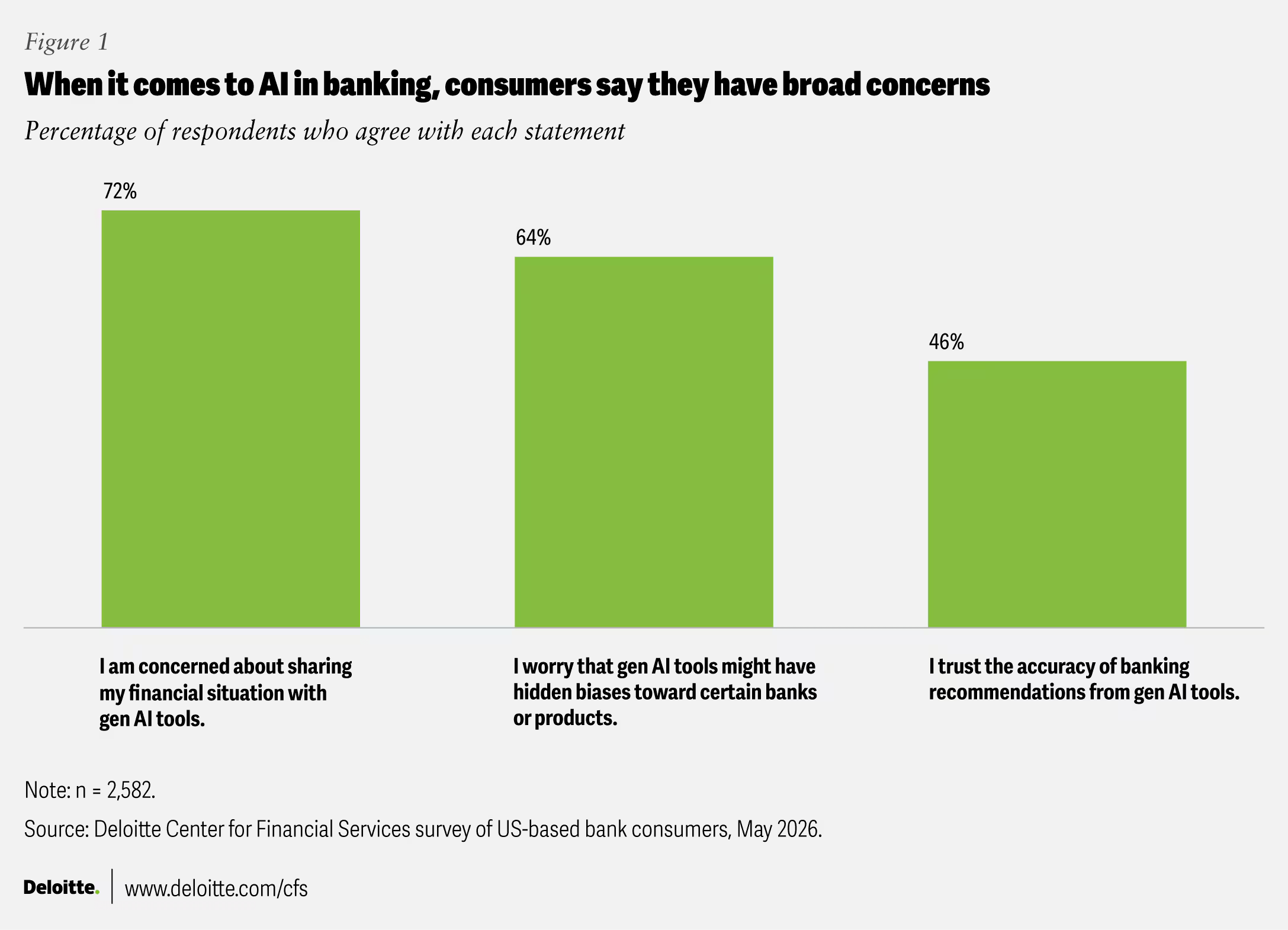
Many banking customers use gen AI tools to research finances but hesitate to share personal data, trust recommendations, or let AI act on their behalf. What can that mean for banks?
Banking consumers are using more generative AI1 as a way to search, sort, and compare options, but Deloitte survey data suggests they remain selective about where they’ll allow AI to go next because they are worried about mistakes and privacy lapses.
Deloitte surveyed almost 2,600 banking customers in the United States and found that 72% of consumers across different ages, genders, and income levels are concerned about sharing information about their financial situation with gen AI tools. Many (64%) also worry about hidden biases. Only 46% of respondents trust the accuracy of banking recommendations from the tools.
By contrast, 79% of bank customers who responded to the survey trust information from their banks’ own websites when researching banking products. That compares with consumers’ trust in traditional search engines (67%), gen AI tools (49%), and social media (28%) (figure 2). This difference between bank websites and gen AI tools reflects trust built by banks over years of regulations and customer experiences. Institutions should sustain this influence by ensuring their information and products are visible as gen AI tools become more popular gateways to financial research.