

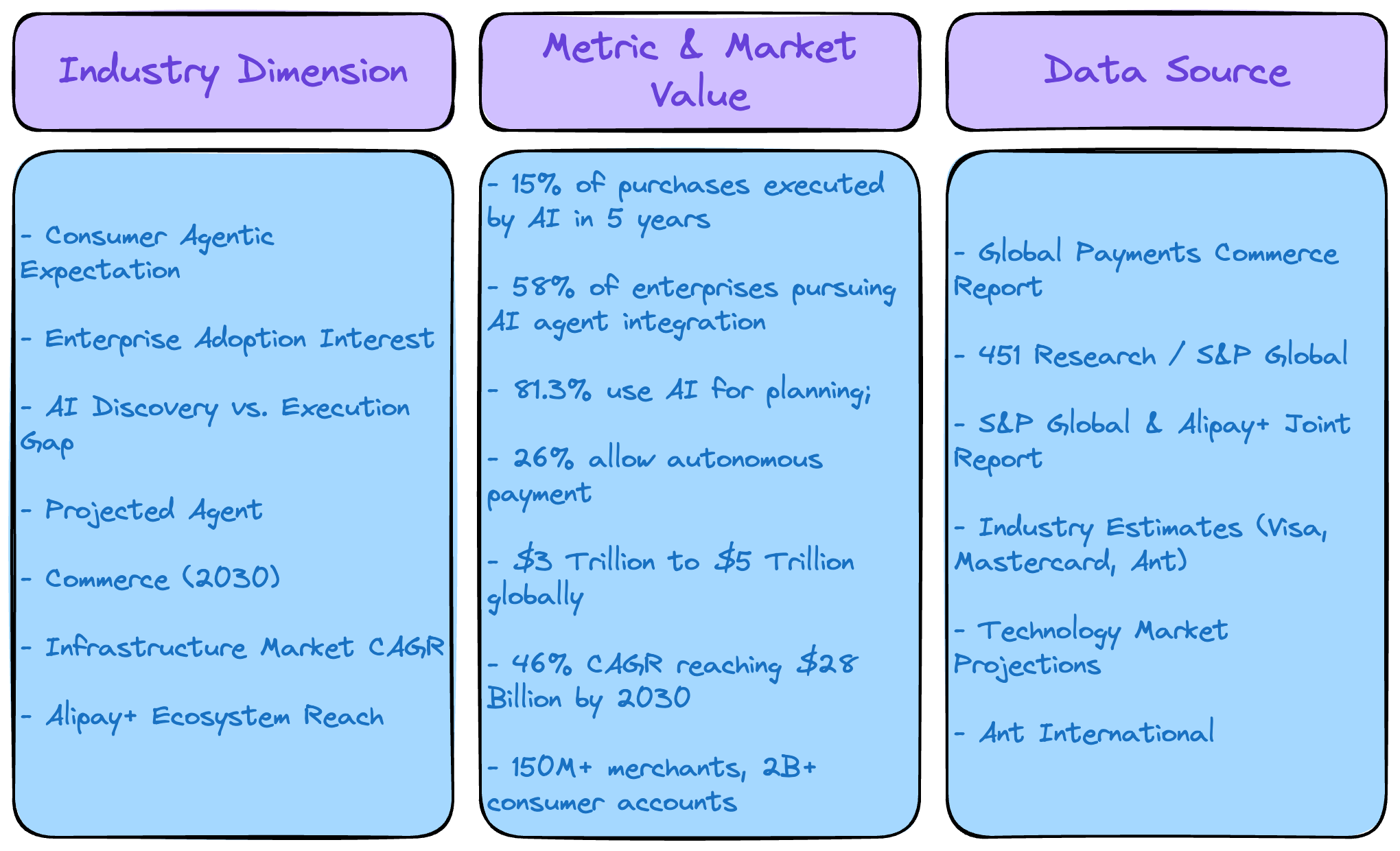
Software agents are transitioning from conversational text generators into autonomous economic actors capable of executing commercial workflows. Recent Global Payments research found that Americans expect AI agents to make 15% of their purchases within five years, up from 9% a year earlier. Research from 451 Research shows that 58% of organizations are actively seeking opportunities to implement AI agent capabilities. By 2030, AI agents are projected to orchestrate $3 trillion to $5 trillion of global consumer commerce.
However, an execution gap remains between using AI for discovery and allowing it to act. Research from Alipay+ and S&P Global found that 81.3% of surveyed consumers already use AI-powered tools to explore travel destinations and experiences. Interest falls as AI moves closer to payments and autonomous decision-making, with 26% expressing interest in those capabilities. The gap points to a trust problem that payment providers will need to address before autonomous execution becomes mainstream.
Legacy payment rails exacerbate this gap. Traditional card-not-present infrastructure relies on human interaction points such as web redirects, visual multi-factor authentication screens, and manual passcodes. Automated agents cannot complete visual verification challenges or enter one-time passwords without custom workarounds. Existing fraud detection systems regularly flag programmatic agent requests as malicious bot traffic, leading to transaction rejections. Traditional card economics can also make high-frequency, sub-cent transactions impractical.
To address these limitations, payment providers are developing agent-native execution layers. Ant International launched the open-sourced Agentic Mobile Protocol (AMP) in April 2026. In its first rollout phase, integration is supported by 10 Alipay+ wallet partners - which together represent 1.5 billion user accounts - and eight leading acquirers: Adyen, Allinpay, Antom, Checkout.com, Fiserv, Global Payments, Nuvei and Worldline. Deploying agentic capabilities across an ecosystem of this size requires an abstraction layer that maintains mobile wallet security while offering programmatic transaction routing.
Enterprise purchasing offers an immediate growth vector alongside consumer applications. In business-to-business environments, agents can manage software subscriptions, media ad spend, and procurement within predefined policy limits. Speaking at the Voyage conference, Ant International Chief Innovation Officer Jiang-Ming Yang noted that he expects adoption to progress faster in business-to-business contexts than in consumer markets in the near-term. Business procurement workflows follow structured operational steps, strict compliance rules, and measurable objectives. This structure simplifies return on investment calculations and accelerates corporate deployment.
Agentic Mobile Protocol architecture
AMP addresses execution friction by connecting AI agents to existing mobile payment infrastructure while keeping authorization boundaries around the user’s account. Its public architecture centers on Know-Your-Agent controls, permissioned delegation, wallet connectivity and agent-to-agent settlement. For payment teams, these capabilities can be understood across three functional layers: trust and identity, payment execution and wallet authorization.
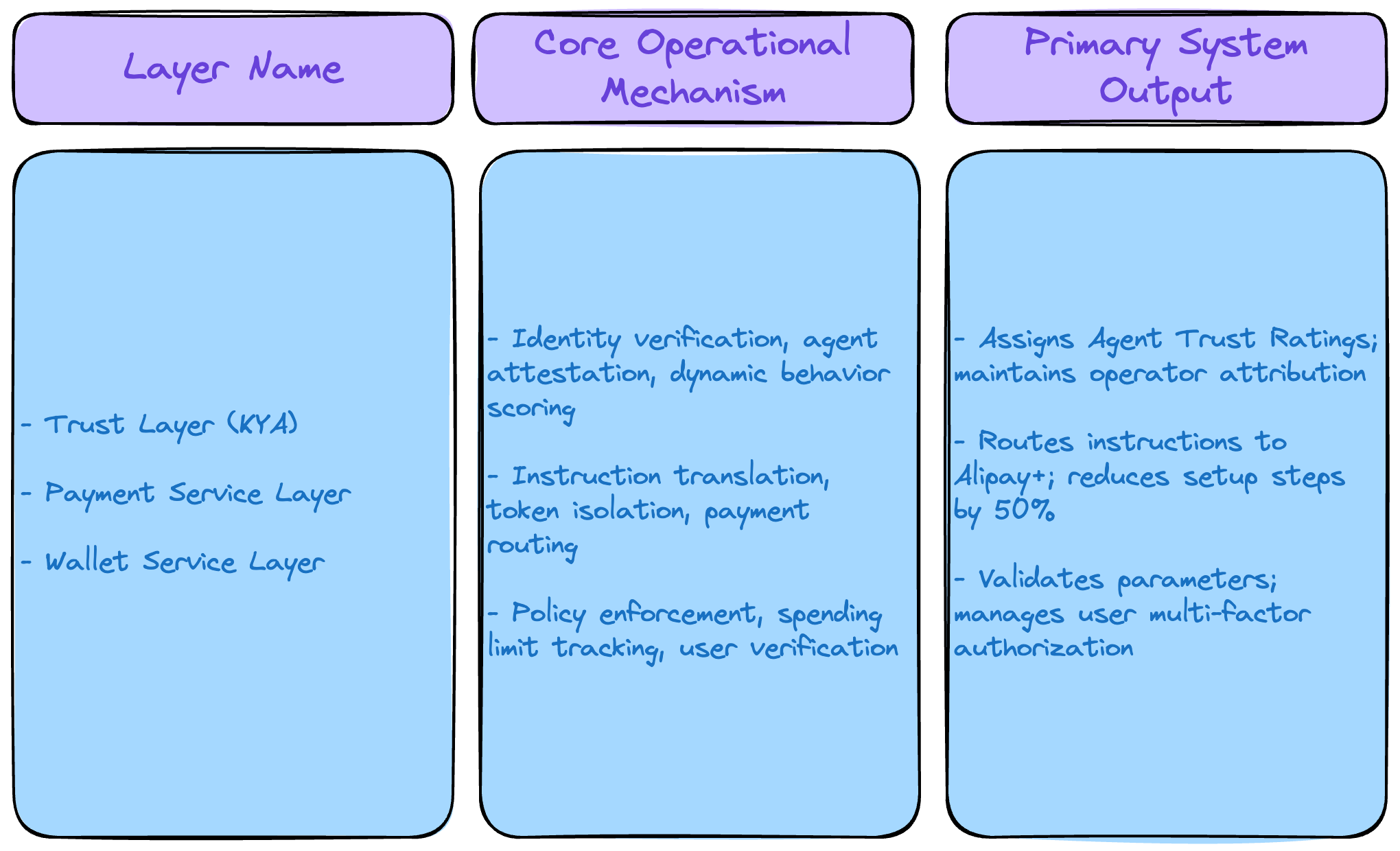
The trust layer starts with Know-Your-Agent (KYA). Ant International describes KYA as a verification process that establishes an agent’s digital identity and certifies its authorized capabilities. AMP adds an Agent Trust Rating, a dynamic risk-management mechanism that assesses whether an agent can be trusted and controls the level of autonomy it receives. Together, these controls are designed to establish who or what is initiating a transaction and what the agent has permission to do.
Industry convergence on identity standards is critical for cross-border scale. Ant International, Visa and Mastercard have begun collaborating on a KYA interoperability framework. The three companies have already developed their own approaches through Ant International’s AMP, Visa’s Trusted Agent Protocol and Mastercard’s Verifiable Intent. The collaboration will explore common principles for agent identification and onboarding across networks while preserving each network’s own verification and decisioning processes. The work also connects with BuildFin.ai, an industry platform convened by the Monetary Authority of Singapore. The collaboration builds on the Safeguards for Agentic Finance at Runtime, or SAFR, framework, which is being developed around safeguards for AI agents operating in financial services.
The Payment Service Layer converts validated agent requests into standardized payment instructions without exposing credit card details, bank credentials, or private API keys. Developers integrate this layer into AI models using open-source software development kits without modifying merchant checkout flows. According to Ant International, AMP cuts the number of steps required to link a payment agent to a digital wallet by 50% compared with traditional card-binding methods.
The Wallet Service Layer maintains mobile wallets at the core of authorization. Mobile payment apps retain administrative control over account funding, multi-factor authentication triggers, velocity limits, and daily spending caps. Before completing the payment, the wallet infrastructure verifies that agent requests match user-defined authorization rules, giving account holders continuous control over financial assets.
How to approach autonomous liability
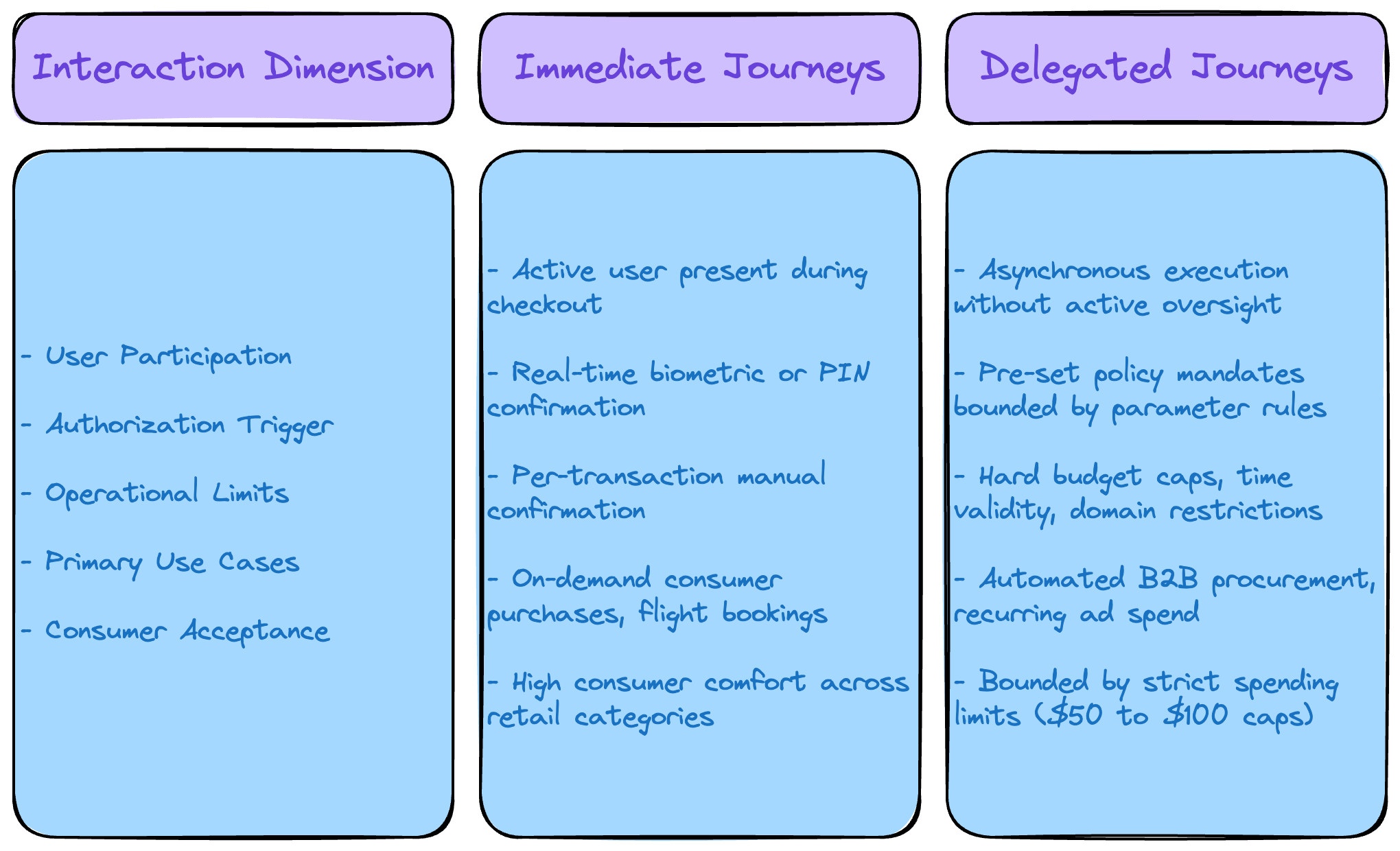
Assigning transaction liability remains a central challenge in agentic commerce. When an agent executes an incorrect purchase or experiences an operational error, payment networks require clear rules to determine financial responsibility. Global Payments research indicates that 50% of consumers cite payment security concerns, while 33% demand explicit per-transaction approval before payments process. The Agentic Mobile Protocol addresses these concerns by establishing two interaction models backed by system risk guarantees.
Immediate journeys cover transactions where the user remains involved during checkout. The agent can handle discovery, product selection and preparation of the transaction while the wallet retains the final authorization step. This reduces manual interaction without removing user control over payment.
Delegated journeys extend the model to tasks that users authorize in advance. AMP is designed around clear permission boundaries: the user authorizes a task rather than handing the agent unrestricted access to an account. Ant says users retain real-time visibility and can modify or revoke delegated tasks. This model allows an agent to operate within an approved mandate while keeping authorization boundaries around its actions.
AMP also introduces AgentSafePay as a risk layer for agent-initiated transactions. Ant International describes it as providing a money-back guarantee for merchants against agentic-specific risks.
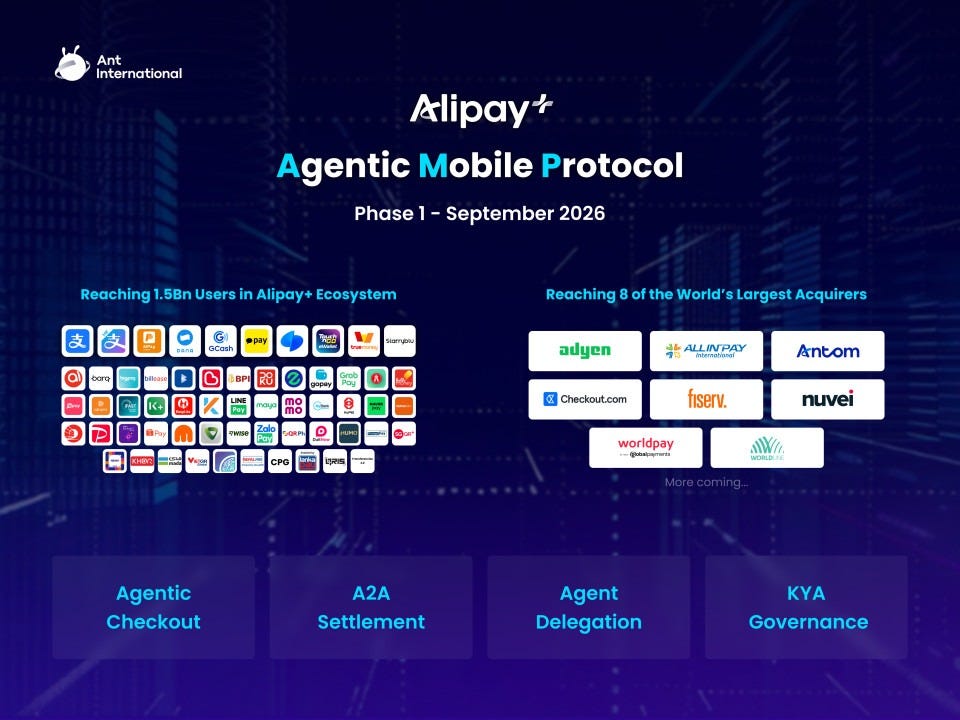
The protocol also includes a high-frequency agent-to-agent settlement engine designed for micro-transactions. Traditional card network fee structures impose fixed costs that make micro-payments inefficient. Ant International says AMP’s high-frequency A2A settlement mechanism can handle transactions as small as $0.000001 between agents, with real-time accounting and clearing. This capability enables software agents to purchase data feeds, compute capacity, and API access on a granular pay-per-use basis without incurring standard card interchange overhead.
Full-stack agentic integration
Global commercial operations require integrated financial technology solutions that extend beyond checkout buttons. As enterprises expand across international markets, operational complexities demand automated management across multi-currency accounts, foreign exchange, treasury operations, and growth workflows. Market research from 451 Research highlights that 58% of enterprises actively seek automated systems to manage cash flow, fraud detection, and credit risk.
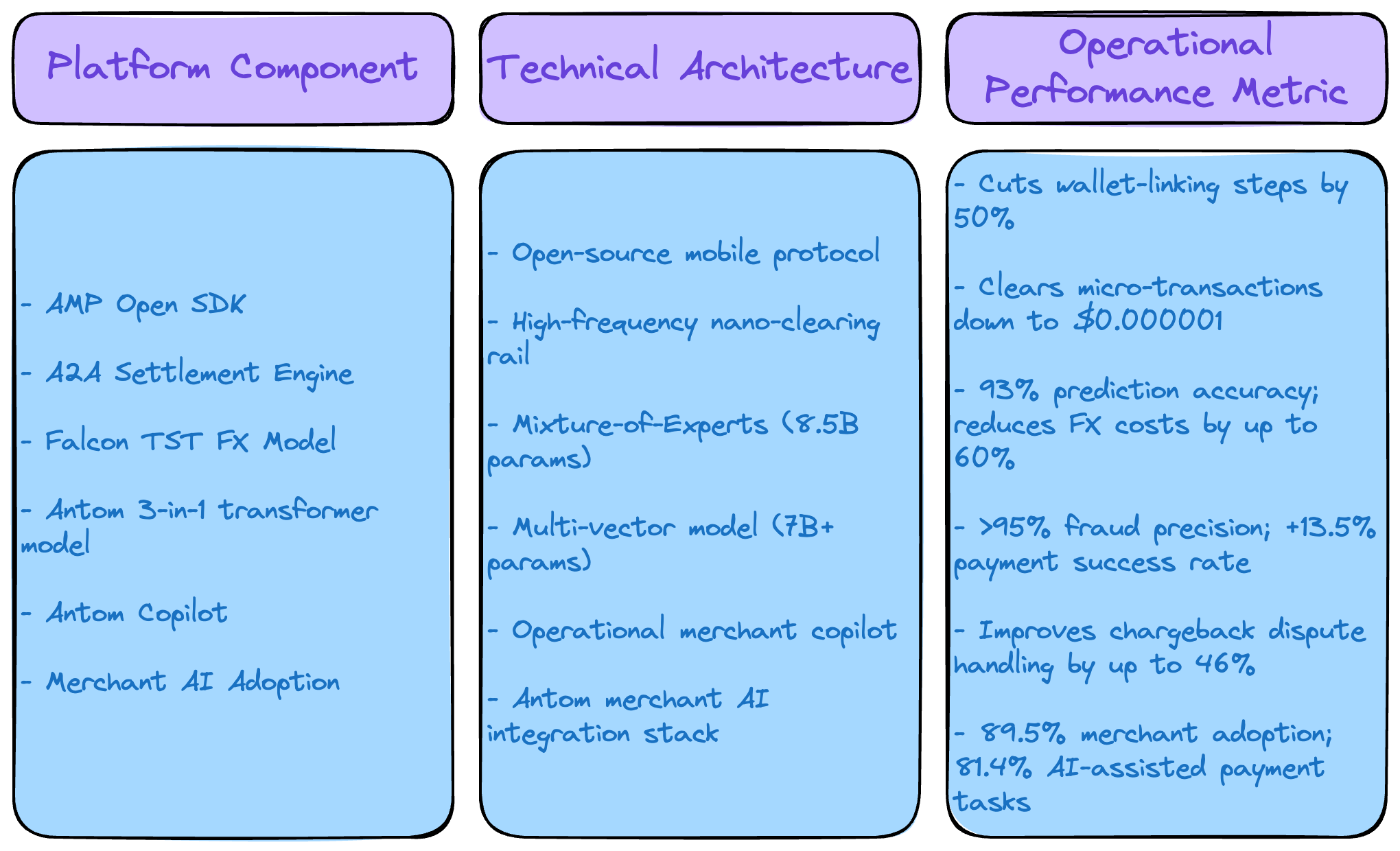
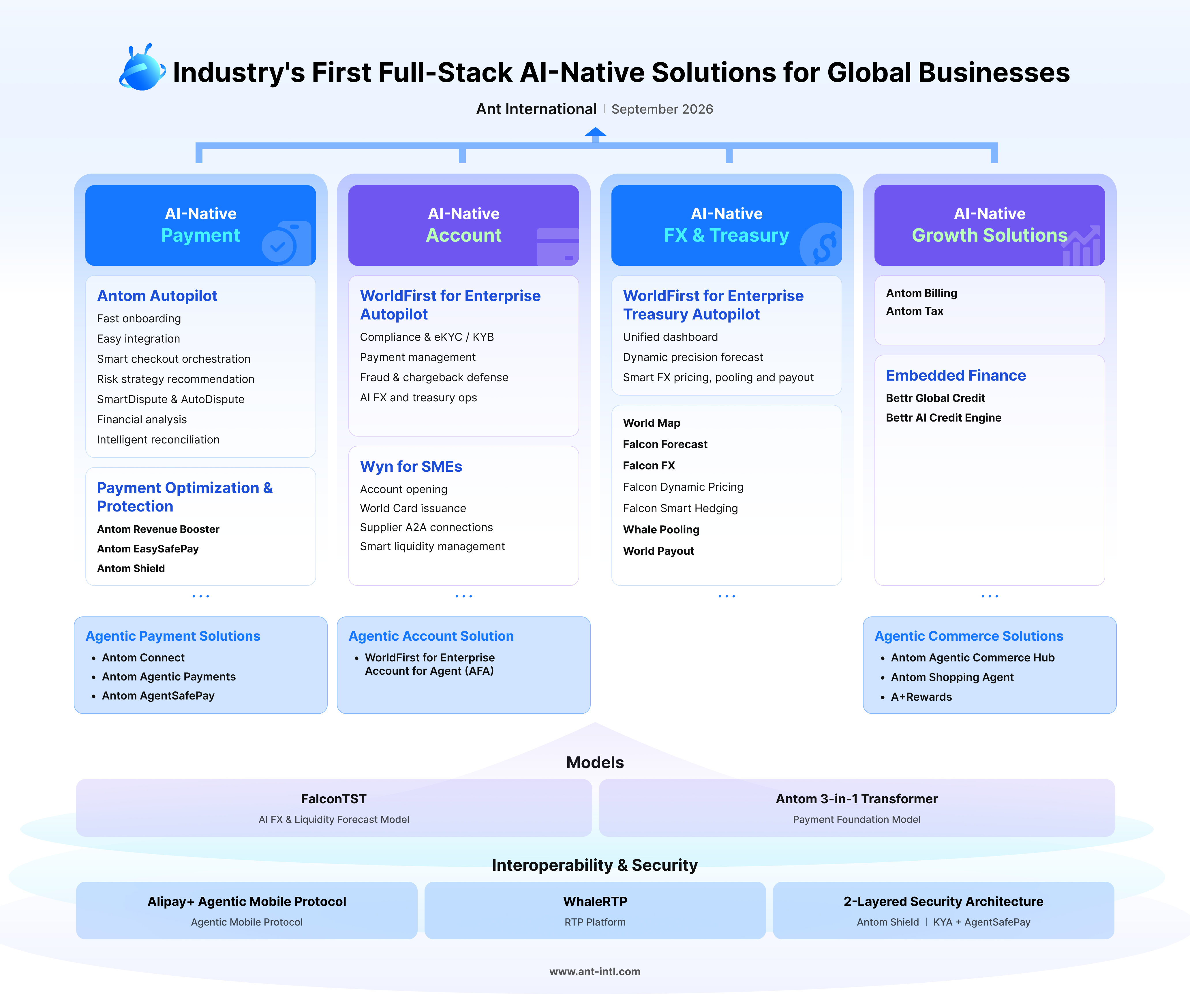
Within this operational stack, multi-currency accounts automate cross-border clearing and liquidity management. Foreign exchange management utilizes specialized AI models to manage currency volatility. Ant International deploys FalconTST for FX and cash-flow forecasting. The company says the model has more than 8.5 billion parameters and has achieved more than 93% accuracy in real-world FX and cash-flow forecasting cases. In those deployments, Ant reports that FalconTST reduced corporate FX hedging and allocation costs by between 30% and 60%.
Growth operations and merchant workflows similarly deploy specialized software agents. Antom Autopilot handles the entire merchant payment lifecycle through a single conversational window, from onboarding and risk protection to revenue recovery and new market expansion. Antom also applies AI to time-intensive merchant tasks like dispute management. Its Antom SmartDispute advises on full dispute management and appeal strategies, and can drive average dispute success rate from 24.5% to 41.8%. Underlying these services is a transformer model that Ant International calls its 3-in-1 payment foundation model. The model combines graph, sequential and tabular data, and identifies high-risk transactions with more than 95% precision and has increased payment success rates by up to 13.5%. Ant International notes that the foundation model is adaptable to general purpose tasks across a range of payment scenarios, from payment protection to account security. The company highlighted that it has now replaced over 200 legacy point solutions with this 3-in-1 transformer model, which allows it to avoid rebuilding from zero when new threats emerge, cutting model development time by 80%.
Ant International says the number of merchants using AI for payment integration quadrupled over the past twelve months. Under Antom, 89.5% of merchants have deployed AI agents, while 81.4% of payment tasks are aided by AI. The company has not disclosed the underlying merchant count or methodology behind these percentages, so the figures are best treated as company-reported indicators of adoption rather than market-wide benchmarks.
As software agents take on more commercial activity, payment infrastructure has to solve a different set of problems from today’s checkout stack. The agent needs an identity. Its authority needs boundaries. Merchants and payment providers need to know who stands behind it. Payment networks also need a way to carry those trust signals across different rails.
AMP is Ant International’s attempt to build that layer around mobile payments. Its scale will depend partly on adoption across Alipay+, but the more consequential work may be happening outside Ant’s own network. The KYA collaboration with Visa and Mastercard is an early test of whether competing agent-payment protocols can establish common trust principles without requiring merchants to integrate another fragmented set of standards.
Sources
Consumers Expect AI to Make 15% of Their Purchases Within Five, https://investors.globalpayments.com/news-events/press-releases/detail/516/consumers-expect-ai-to-make-15-of-their-purchases-within
Payment trends update: how agentic AI is disrupting payments, https://www.visaacceptance.com/en-us/blog/article/2025/how-agentic-ai-is-disrupting-payments.html
Ant International, Mastercard and Visa Initiate Collaboration on, https://www.ant-intl.com/en/news/detail/?id=ant-international-mastercard-and-visa-initiate-collaboration-on-know-your-agent-interoperability-to-scale-agentic-commerce
Ant International Launches Open-Sourced Agentic Mobile Protocol, https://www.ant-intl.com/en/news/detail/?id=ant-international-launches-open-sourced-agentic-mobile-protocol-to-drive-ai-commerce&tag=AI
Interoperability and Trust Key to AI Commerce: Alipay+ and S&P, https://www.newswire.co.kr/newsRead.php?no=1041724
Ant International’s Agentic Mobile Protocol Rolls Out Globally with, https://www.ant-intl.com/en/news/detail/?id=ant-internationals-agentic-mobile-protocol-rolls-out-globally-with-wallets-acquirers-initiating-collaboration-on-kya-interoperability-framework-with-mastercard-and-visa&redirect=news&tag=AMP%2CPARTNERSHIP
Expanding infrastructure for the age of AI commerce - Ant International, https://www.ant-intl.com/en/news/detail/?id=expanding-infrastructure-for-the-age-of-ai-commerce-ant-international-connects-over-150m-merchants-with-more-than-2b-consumers
MAS Partners Industry to develop Safeguards for AI Agents in Finance, https://www.mas.gov.sg/news/media-releases/2026/mas-partners-industry-to-develop-safeguards-for-ai-agents-in-finance
Ant International Launches Industry’s First Full-Stack AI-Native Solutions for Payment, Account, FX, Treasury and Growth Operations for Global Businesses
https://www.ant-intl.com/en/news/detail/?id=ant-international-launches-full-stack-ai-native-solutions-for-payment-account-fx-treasury-and-growth-operations-for-global-businesses&redirect=news&tag=VOYAGE%2CAI%2CANTOM%2CALIPAY%2B%2CPARTNERSHIP%2CFALCONTST%2CBETTR
Disclaimer:
Fintech Wrap Up aggregates publicly available information for informational purposes only. Portions of the content may be reproduced verbatim from the original source, and full credit is provided with a “Source: [Name]” attribution. All copyrights and trademarks remain the property of their respective owners. Fintech Wrap Up does not guarantee the accuracy, completeness, or reliability of the aggregated content; these are the responsibility of the original source providers. Links to the original sources may not always be included. We use AI tools to brainstorm, draft, edit, and summarize, but the ideas, analysis, and connections Sam draws are his. Every piece is verified and written in Sam’s voice. For questions or concerns, please contact us at sam.boboev@fintechwrapup.com.