

This week’s reports explore key developments in digital payments, banking consolidation, and stablecoin adoption. The World Payments Report 2027 highlights intelligent payment instruments, while The Future of Cross-Border Payments 2027 emphasizes real-time liquidity and interoperability. BCG’s analysis stresses sustainable revenue growth, stronger customer relationships, and cost efficiency to restore investor confidence. Bain predicts further US banking consolidation by 2030. Meanwhile, industry updates highlight Stripe’s expansion into embedded lending, Circle’s acquisition of Tazapay to strengthen cross-border payments, and stablecoins’ growing role in B2B international settlements, where faster transactions and lower transfer costs offer practical advantages.
Video of the Week
Deep Dive of the Week
Why US banks are blocking third-party AI agents

I was at NVIDIA GTC in Berlin this week, where the discussion around OpenShell brought me back to a question facing every bank building with AI: how much authority should an agent have once it reaches a customer’s money?
Major US banks are already answering that question by restricting outside agents. Their concern is understandable. An assistant using a customer’s login can look like the customer while making decisions the customer never specifically approved.
But banks also have a commercial interest in controlling that access. An agent that manages money across institutions could make deposits much easier to move and weaken the bank’s position as the customer’s main financial interface.
The access rules being written now will determine how much of that competition can develop.

This week’s reports
1️⃣Quick Start Guide for New Card Programmers in the UK
2️⃣World Payments Report 2027
3️⃣How to Find the US Bank M&A Targets Everyone Else Is Missing
4️⃣The Future of Cross-Border Payments 2027: Forging Interoperability
5️⃣How Payments Companies Can Regain Investor Confidence
6️⃣Payments & Transaction Processing
7️⃣FurlPay Global Stablecoin Report 2026
Quick Start Guide for New Card Programmers in the UK
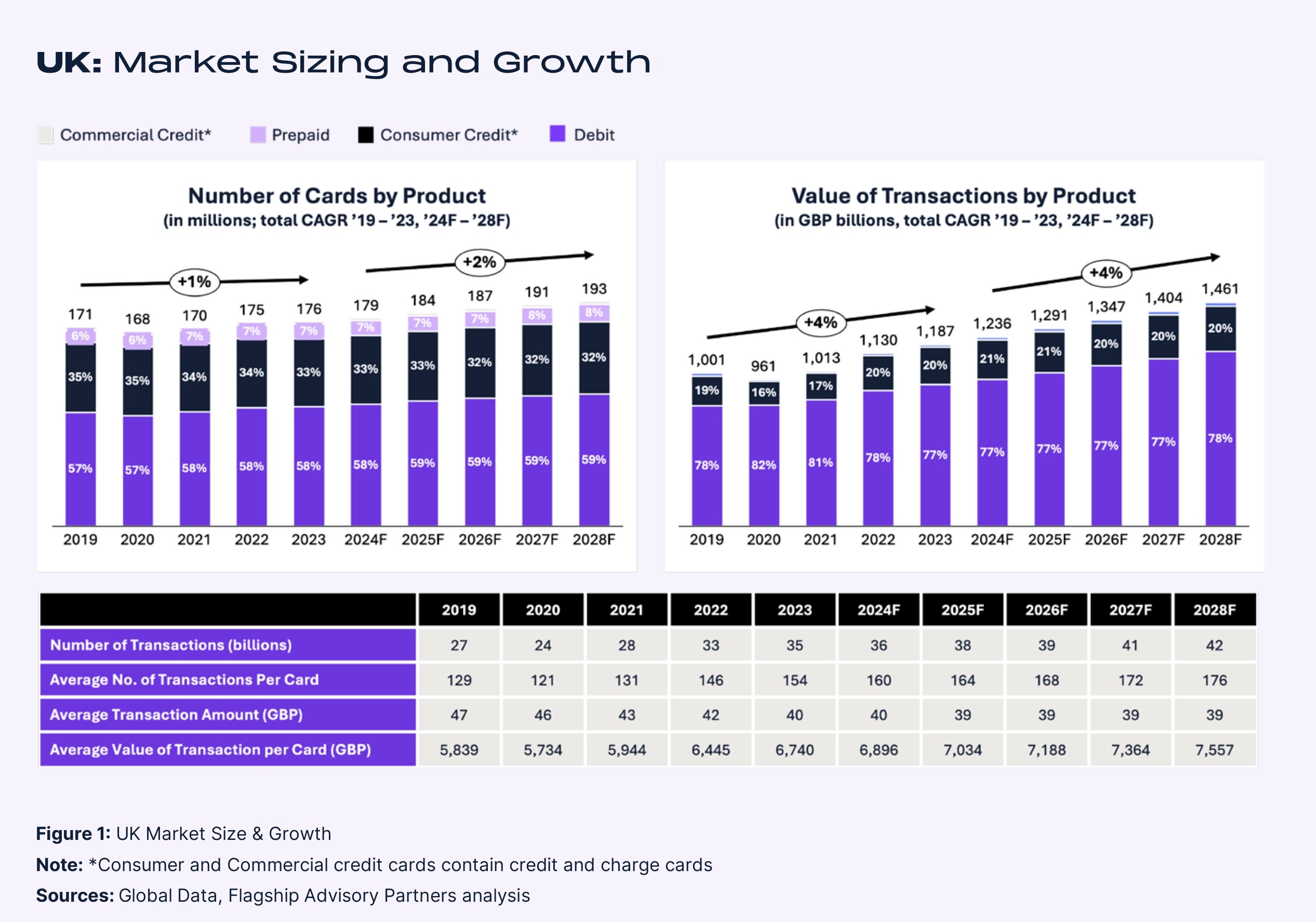
To run a successful payment card programme, it is essential to have a comprehensive understanding of the market in which the programme will launch.
Although there are many decisions to be made when launching a new programme, there are many good reasons to do so. For financial services companies, cards programmes can either be a core product with direct revenue generation (e.g., to access a current account, or to extend credit), or a means to expand the product catalog and provide a valuable service to existing customers (e.g., marketing expense management cards to small merchants). For non-financial services companies, card programmes provide utility for broader initiatives (e.g. a payment card wallet in an app), can facilitate loyalty programmes based on personalised customer-specific spending data, or increase customer purchasing power via provision of credit.