

I was at NVIDIA GTC in Berlin this week, where the discussion around OpenShell brought me back to a question facing every bank building with AI: how much authority should an agent have once it reaches a customer’s money?

Major US banks are already answering that question by restricting outside agents. Their concern is understandable. An assistant using a customer’s login can look like the customer while making decisions the customer never specifically approved.
But banks also have a commercial interest in controlling that access. An agent that manages money across institutions could make deposits much easier to move and weaken the bank’s position as the customer’s main financial interface.
The access rules being written now will determine how much of that competition can develop.
What banks are actually blocking
JPMorgan’s Jamie Dimon warned about “rogue agents” during the bank’s October earnings discussion. Reuters subsequently reported that US banks were blocking third-party agents, including transactions flagged after customers shared credentials. Morgan Stanley said it had not identified rogue activity on its platforms, an important qualification to the wider reporting.
Citi’s position draws a useful boundary: outside agents cannot log into customer accounts or transact directly, while read-only access through certain open-banking providers remains available. Bank of America has also imposed restrictions. Brian Moynihan has called for human involvement in the process.
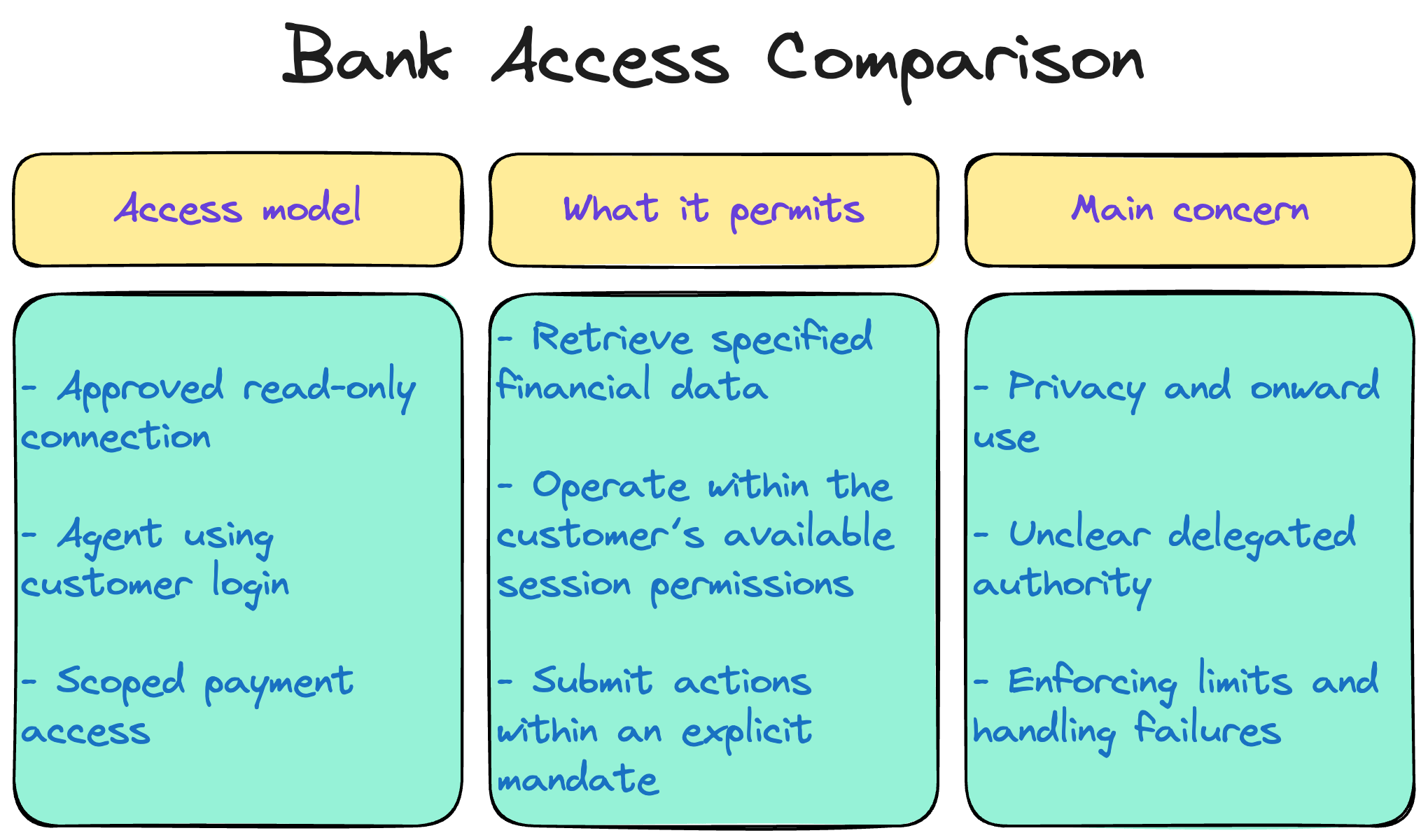
“Banks are blocking AI” therefore misses the detail that matters to product teams. Reading a balance through an approved connection and operating a banking session with someone’s password are different access models. Neither should automatically confer permission to move money.
Customers may welcome an assistant reviewing spending. That does not tell the bank whether it can trust the same assistant to change a beneficiary or submit a transfer.
A successful login leaves the hardest questions unanswered
Consider a customer asking an agent to “put my spare cash somewhere better.”
The customer probably expects the agent to leave enough for rent and upcoming bills. They may assume the destination has the same protections as their existing account. They may never have considered whether a transfer takes several days to reverse.