


What does stablecoin compliance look like in 2026? We are all busy with technology and how great it is, but without the right compliance, stablecoins won't work.
Between 2023 and 2026, the GENIUS Act, MiCA, the UK's FCA regime, and dedicated frameworks from MAS, the HKMA and VARA all came into force on top of a rewritten FATF Travel Rule.
Now the question is which rules apply to your specific activity, and that rarely has a simple answer. A bank or a payments company can all touch the same stablecoin and carry completely different obligations, depending on their role and stacks.
If you want to understand what compliance frameworks apply to your business, Sumsub's report helps to clarify:
- What the seven frameworks that matter — GENIUS, MiCA, the FCA regime, MAS, HKMA, VARA, and the FATF Travel Rule — actually require, and where each one stands today
- How obligations differ depending on what you do: issuing, custody, payments, wallets, banking, or card programs
- The common pitfalls compliance teams hit when stablecoin activity gets bolted onto an existing program instead of built into it
- A practical readiness checklist for each business segment, so you can test whether your controls are keeping pace with regulatory expectations
You'll also see where the rules are trending. FATF Travel Rule adoption has reached 83% of surveyed jurisdictions, up from 73% a year earlier. Stablecoins' share of crypto transfers has climbed from 31% to 36% over the same period. The scrutiny has shifted too, from checking whether a policy exists on paper to testing whether controls actually work in practice. This guide shows what that bar looks like for your segment.
Video of the Week
Deep Dive of the Week
The AI Model Gateway/Router Directory For Fintechs and Banks

Stripe just acquired OpenRouter for more than $7 billion, roughly five times the valuation OpenRouter carried three months ago. A payments company just paid a premium to own the layer that decides which LLM handles a request, at what cost, and with what fallback path. If you build fintech products on top of LLMs, this is no longer a developer tooling question. It is an infrastructure decision with the same weight as picking a payments processor or a core banking vendor.
Stripe’s acquisition of OpenRouter turns AI gateways from a nice-to-have into infrastructure banks and fintechs need to evaluate seriously. This guide maps 16 AI gateway and LLM routing platforms across five categories, with the deployment models, compliance posture, and pricing structures that matter when you handle regulated data. I built it because most comparisons of this category are written for general SaaS teams, not for people who need to answer a compliance questionnaire before they ship. Structured profiles and a companion Excel file with seven filterable tabs are below the paywall. Use it to shortlist vendors before your next infrastructure review.

This week’s reports
1️⃣The Next Payment Infrastructure in Africa
2️⃣AI and Stablecoins’ Transformation of the Global B2B Payments Experience
3️⃣UAE Digital Assets and Stablecoin Ecosystem
4️⃣Stablecoin playbook
5️⃣Q2 2026 Quarterly FinTech Insights
6️⃣Revolut - The Dawn of Modern Banking
7️⃣Stablecoins in Europe
The Next Payment Infrastructure in Africa
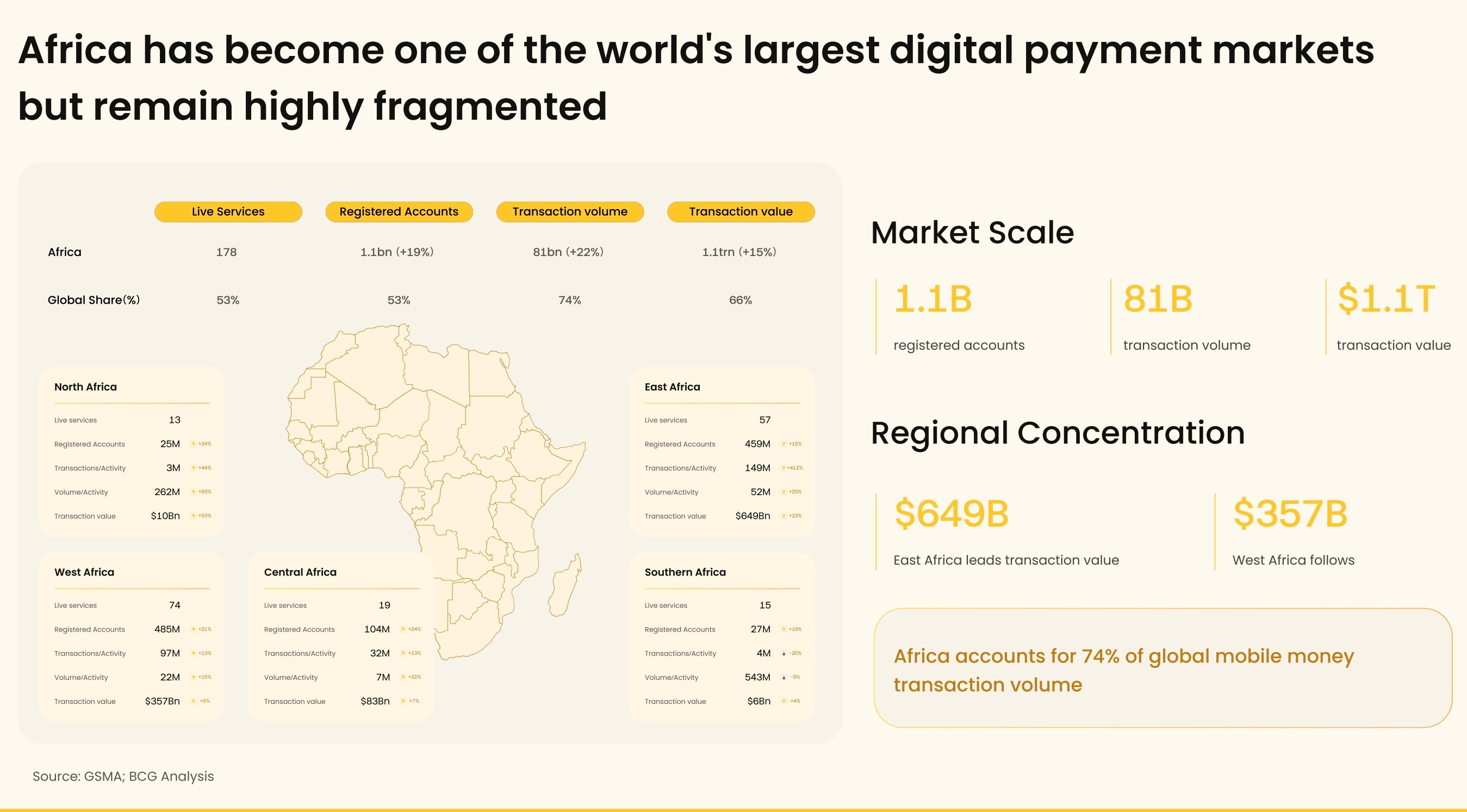
Africa has built one of the world’s most dynamic financial ecosystems by leapfrogging traditional banking infrastructure directly into mobile-first networks. Driven by a young median age of 20 and rapid urbanization, domestic demand for digital services, e-commerce, and merchant payments continues to accelerate.
However, domestic digital success has not created a unified continental ecosystem. Payment adoption remains deeply uneven — spanning from over 70% digital payment usage in Senegal to under 10% in Niger. For businesses, domestic efficiency stops at national borders, exposing a stark contrast between fast local mobile transactions and complex, costly cross-border commercial settlement.
Four Frictions Limiting Payment Efficiency
While domestic Instant Payment Systems (IPS) expanded to 33 active networks generating 65.6 billion transactions in 2024, cross-border business payments remain constrained by severe structural inefficiencies:
The Formalization Gap: With 85.8% of African employment situated in the informal economy, smaller enterprises and merchants struggle to access standardized formal banking and payments.
Payment Rail Fragmentation: Incompatible technical and regulatory frameworks across national borders restrict direct payment routing and degrade cross-border success rates.
FX and Liquidity Traps: Currency fragmentation forces intra-African commercial transactions through foreign currencies and overseas correspondent banks, generating an estimated $5 billion annually in unnecessary transaction costs.
Settlement Latency: Multi-hop correspondent banking pathways increase processing friction, resulting in high fees and settlement delays spanning multiple business days.
Stablecoins as a Value Movement Layer for Global Trade
To overcome traditional banking friction, commercial enterprises across Africa are turning to alternative blockchain-based settlement mechanisms. Between July 2024 and June 2025, Sub-Saharan Africa received approximately $205 billion in total on-chain value (+52% YoY).
Dollar-denominated stablecoins (such as USDC and USDT) are increasingly integrated into real-world trade flows between Africa, the Middle East, and Asia — including multi-million-dollar energy and merchant settlements. By routing value across blockchain networks into local off-ramps, stablecoin pathways reduce correspondent banking bottlenecks, secure dollar liquidity, and compress cross-border settlement from days to minutes while lowering costs from $5–$15+ to under $1.
AI and Stablecoins’ Transformation of the Global B2B Payments Experience
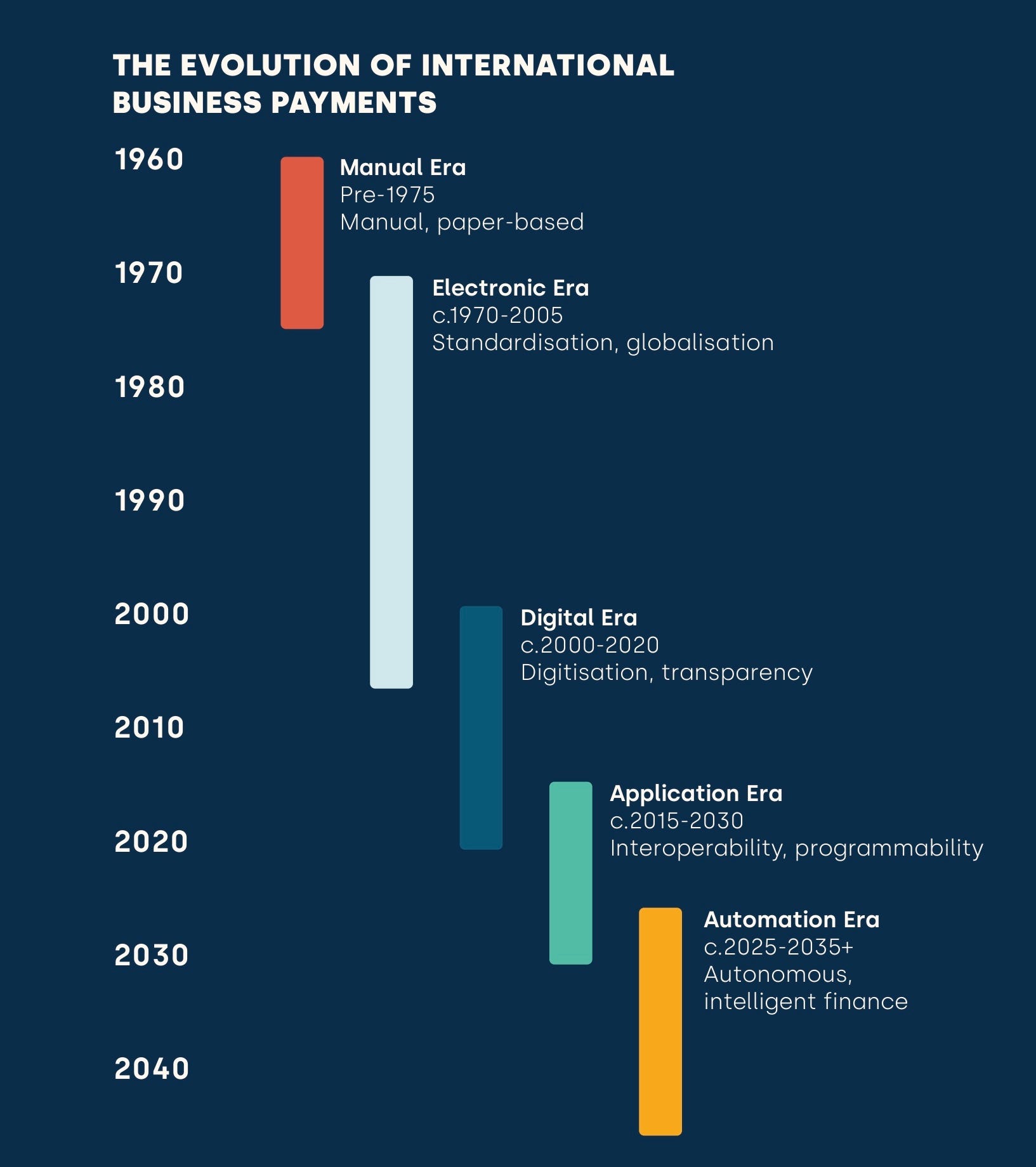
Artificial intelligence is by no means new to payments. Earlier forms of the technology have played a role in cross-border transactions for some time, particularly in areas such as know-your-customer (KYC) and fraud mitigation. But recent developments have progressed the technology considerably.
The evolution of generative AI and large language models (LLMs) such as ChatGPT and DeepSeek initially sparked a surge of hype across payments and beyond. Boardrooms around the world were seized with discussion on how the technology could help their bottom line – as well as how it might erode their well-honed business models.
The technology was subject to a lot of excited discussion, but also a lot of noise and exaggeration. Now the hype has reduced, the actual benefits are easier to see – and for business payments, the use cases are significant.
AI’s Payments Impact: Numbers from the Industry
+9-15% Mastercard has seen from initial trials of its AI-based Payment Optimization Platform for merchants
-75% support times money transfers provider Remitly saw when it launched its AI-powered virtual assistant
-30% The drop in fraud losses from card scams that Revolut saw after it introduced a new AI-based feature to detect if a customer was being scammed
+200% efficiency SUNRATE saw from its internal AI tool
$3tn-$5tn The opportunity that J.P. Morgan sees in “services as a software” – the delivery of business services via AI-powered software platforms
50+ The number of use cases Swift is testing or using AI for, including fraud detection, information sharing and efficiency improvements
Report by FXC Intelligence and Sunrate
UAE Digital Assets and Stablecoin Ecosystem
Five years after establishing VARA as the world’s first dedicated virtual asset regulator, the UAE’s digital asset ecosystem has moved from framework-building into regulated commercial execution.
The May 2026 MENA Fintech Association roundtable at Daos Hub reflected this shift: discussion centered not on whether to regulate, but on converting existing infrastructure into economic activity at scale. AED stablecoin initiatives have moved toward operational use. VARA-licensed VASPs now number 50, with the regulator targeting 80% by year end. On May 12, the UAE approved crypto for government fee payments. DDSC’s dirham-backed stablecoin ecosystem (IHC, First Abu Dhabi Bank, Sirius) received Central Bank approval, and IHC executed a ~AED 110 million (~USD 30 million) transfer on ADI Chain — one of the UAE’s largest disclosed stablecoin transactions. The UAE’s positive FATF standing further reinforced compliance confidence.
Three themes emerged. First, stablecoins are now operational reality: global on-chain settlement volume hit a gross USD 33 trillion in 2025 (75% YoY growth), surpassing combined Mastercard/Visa volumes — though bot-adjusted figures put genuine economic activity closer to USD 9 trillion. The AED stablecoin is live domestically, but cross-border adoption lags due to onshore custody requirements and unstandardized FX swap workflows.
Second, banking access remains a core operational challenge — licensing alone doesn’t resolve the need for operating accounts, client money accounts, and correspondent banking, particularly for firms serving multiple jurisdictions.
Third, global competition has intensified. The UAE’s early-mover advantage is being tested as the US (GENIUS Act enacted, Clarity Act advancing) and EU (MiCA established) build clearer frameworks. Going forward, UAE’s edge will depend less on being first and more on ecosystem depth and commercial effectiveness.
The foundation is strong; the next phase hinges on scaled commercial use, deeper bank participation, cross-border settlement, and coordinated infrastructure — converting regulatory leadership into durable market leadership.
Insights by MENA FINTECH ASSOCIATION
Stablecoin playbook
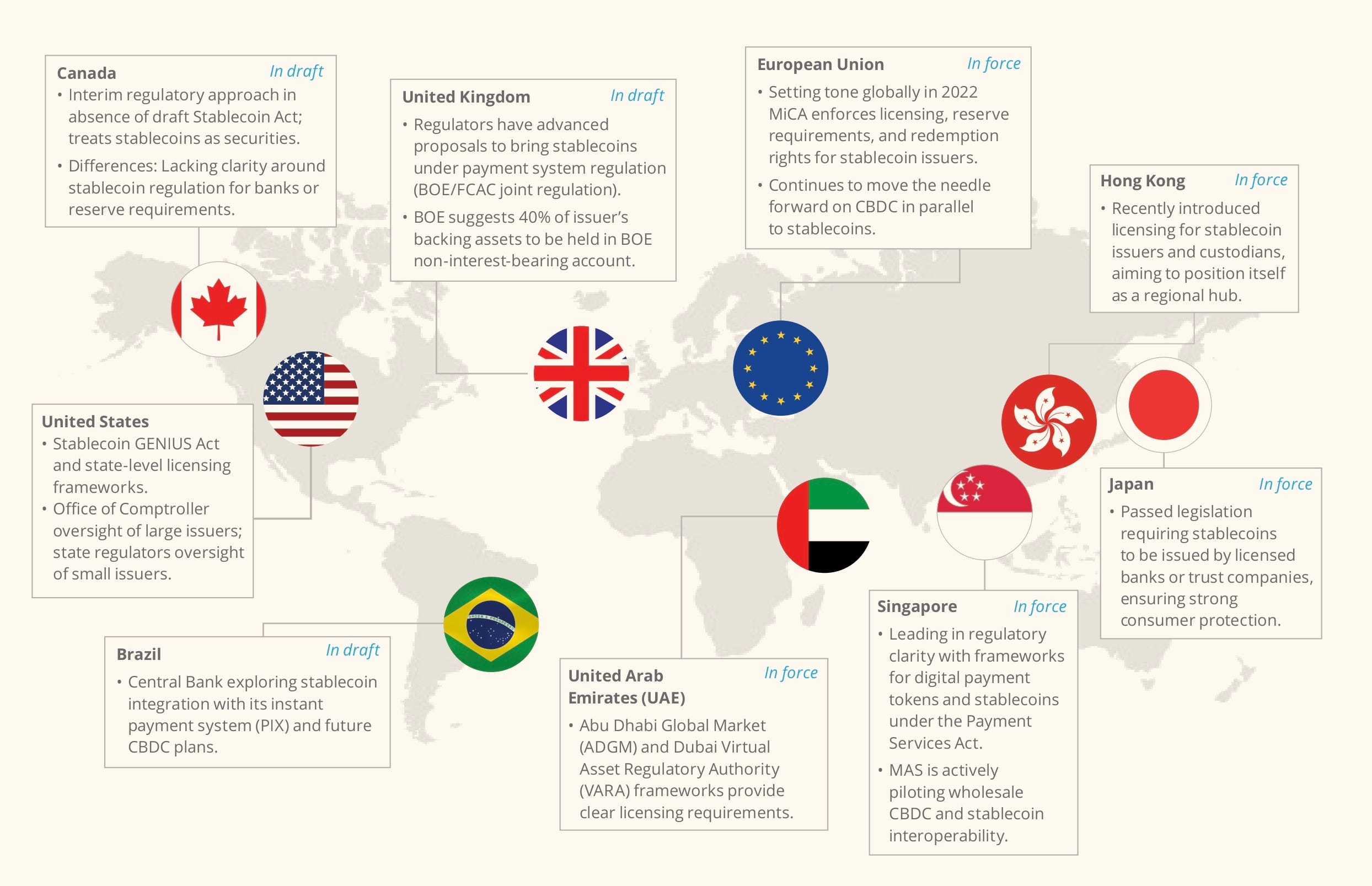
The global financial system is standing at the threshold of a fundamental reset. Stablecoins, digital assets whose value is pegged to a stable reference, most often a single fiat currency such as the US dollar, have emerged as a critical foundation for the new financial infrastructure. These fiat-linked stablecoins, fully backed by cash or cash equivalents and designed for minimal price volatility, offer the trust and stability required for mainstream adoption.
Financial products are transitioning on-chain, with tokenized versions of regulated assets (e.g., stocks, funds, deposits) now operating on public blockchain infrastructure. The transition is shifting how value is stored, transferred, and programmed. Stablecoins have evolved from simple trading pairs for crypto markets to becoming the backbone of programmable money. This shift toward a digitally native financial system is explored further in “From vaults to virtual: Digital revolution in the financial system.” Forward-thinking institutions now see stablecoins as strategic solutions to long-standing challenges in cross-border payments, treasury operations, and liquidity management. Increasingly, stablecoins serve as the foundational settlement layer for a tokenized financial ecosystem.
As of April 2026, the stablecoin market is valued at approximately US$316 billion, with Citi projecting issuance of US$1.9 trillion (base case) to US$4 trillion (bull case) by 2030. This exponential growth signals digital-dollar infrastructure maturing into mainstream financial plumbing, driven by institutional demand, the need to address correspondent banking friction, and the rise of programmable payment rails. This transformation aligns with long-awaited regulatory clarity, as the US Guiding and Establishing National Innovation for US Stablecoins Act (GENIUS Act), the EU Markets in Crypto-Assets Regulation (MiCA) framework, and emerging licensing regimes establish robust compliance pathways around the globe.
US dollar-denominated stablecoins currently dominate existing issuance and usage. Whether this dollar dominance persists will depend on regulatory clarity and market structure outside the US, demand for local-currency settlement, and the emergence of credible alternatives (e.g., euro or other major-currency stablecoins and tokenized deposits) that can match USD stablecoins on trust, liquidity, and interoperability, particularly in regional payment corridors and multicurrency corporate treasury use cases.
Q2 2026 Quarterly FinTech Insights
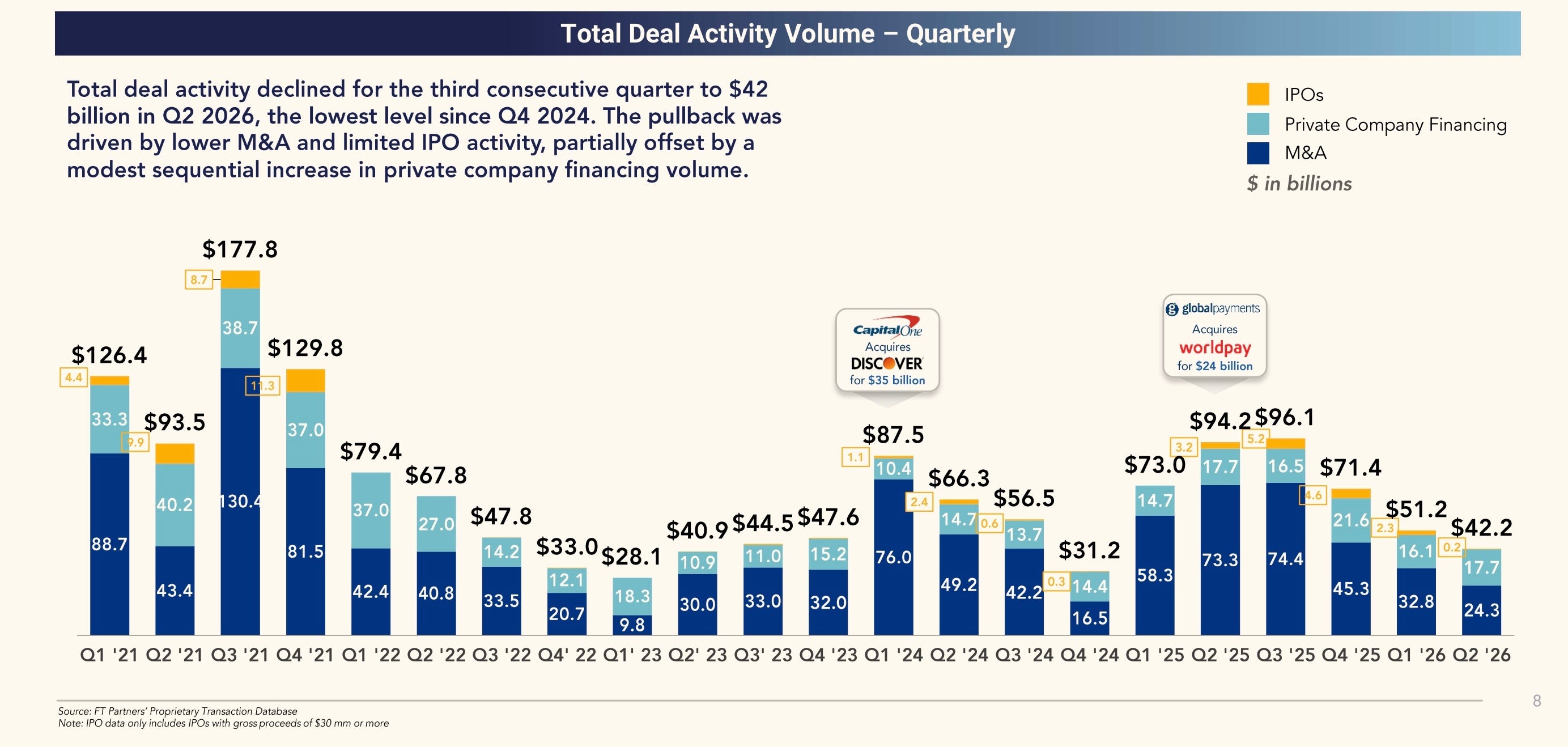
Key Insights:
- Public Markets & IPO Pause
IPO Slowdown: Public-market activity dropped sharply following Q1’s five U.S. IPOs ($2.0B raised).
Overall Volume: Total FinTech deal volume fell for the 3rd consecutive quarter to $42.2B (lowest since Q4 2024).
International Listings: International IPO activity was minimal, totaling ~$0.2B combined from OnEMI Technology Solutions and Sunmi.
- Private Capital & Mega-Rounds
Private Funding Rebound: Private financing rose to $17.7B (vs. $16.1B in Q1 2026 and flat YoY vs. Q2 2025).
Capital Concentration: Growth was heavily skewed toward six $500M+ megadeals ($4.2B volume). Excluding these, underlying financing declined.
Deal Count Drop: Overall deal count fell 14% Q-o-Q to 696 deals (down 29% YoY). However, 43 deals topped $100M+ (highest quarterly total since Q3 2022).
Stage Breakdown:
Seed & Series A: Stable at 230 deals ($2.8B).
Series B+: Up to 74 deals ($7.8B) vs. $6.7B in Q1.
Top Sector & Investors: Financial Management Solutions led early and late stages. Andreessen Horowitz led VC activity (22 new, 34 total H1 deals). Coinbase Ventures and Tether were top strategic investors. Corporate participation hit 37% overall and 56% in Crypto/Blockchain.
- Unicorns & Major Financing Rounds
New Unicorns (Q2): Corgi ($2.6B), D360 ($1.6B), KreditBee ($1.5B), Slash ($1.4B), nesto ($1.05B), and Farther ($1.0B).
Valuation Increases: Ramp ($44B), Airwallex ($11B), AlphaSense ($7.5B), Alan ($6.3B), and Mercury ($5.2B).
Largest Rounds:
CRED ($900M Series H)
Ramp ($750M Series F)
Ebury ($742M Strategic)
Alan ($550M Series G)
Clip ($500M Late-Stage)
- M&A Activity ($24.3B Total Volume)
M&A stepped down from 2025’s pace with zero $15B+ transactions, but strategic acquirers drove key infrastructure consolidation:
Bullish \ Equiniti ($4.2B): Market infrastructure meets tokenization.
Nuvei \ Payoneer ($2.75B): Cross-border payments and stablecoin-enabled commerce consolidation.
Wafra \ Navitas ($1.9B): Sponsor appetite for specialty finance.
Other Notable Deals: Adyen / Talon.One ($880M), PayPay / T&D Financial Life ($840M), CoStar / Zonda ($800M), Amex / TheFork ($700M), Kraken / Reap ($600M), and Kraken / Bitnomial ($550M).
Revolut - The Dawn of Modern Banking
Key insights:
For the love of product.
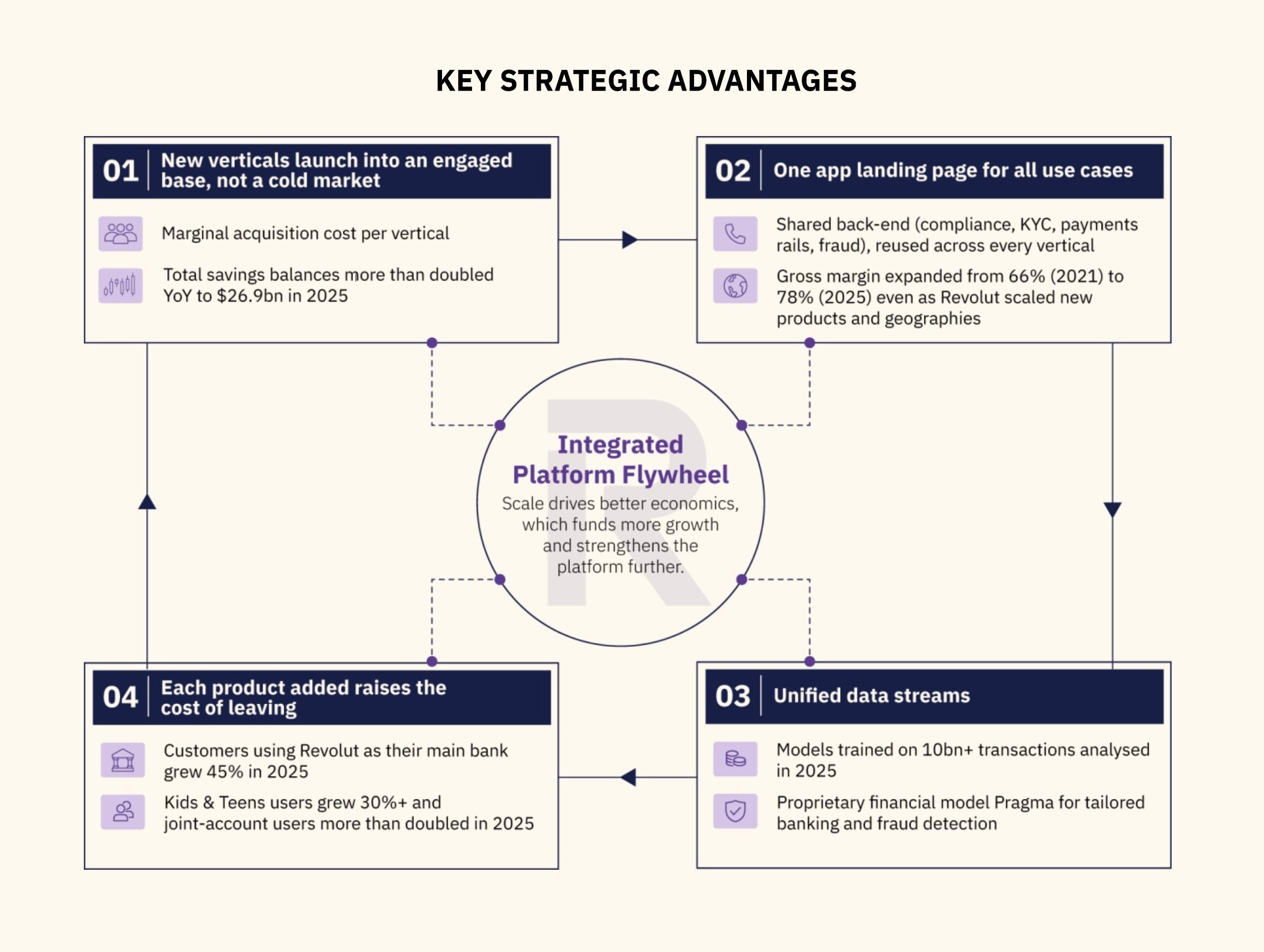
Product is the growth engine. Every product must “deliver WOW”, and customers reciprocate: around two-thirds of new customers arrive organically or by referral, and every new vertical launches into an already engaged base at minimal acquisition cost, creating a flywheel where each product deepens retention and funds the next. The same discipline now extends to AI, with AIR putting the entire ecosystem behind a single conversational interface.
Complexity that feels simple.
Rivals, at best, focus on product breadth or monetisation depth; Revolut is successfully doing both, distributing institutional-grade, high-margin products to a 75-million-user base through the same daily habit that began with free FX. Three moats - distribution, in-house technology and the proprietary data those users generate - reinforce one another, and the combined advantage compounds with every launch.
Sustainable product velocity.
Each product launch reaches milestones faster than the previous one. New verticals inherit a base that is already at scale and infrastructure that the earlier products had paid for. Payments took eight years to mature, wealth took six, RevPoints is moving faster still. In the UK, the world’s most competitive fintech market, a new core vertical roughly every 18 months took Revolut from zero to 13 million customers by 2025.
Standardise to scale, localise to win.
One playbook, 48 countries. Revolut runs a single global technology stack and brand, but calibrates market entry, product sequencing and licensing to each geography. Having hard-won its home base in Europe, Revolut is now replaying that playbook across Latin America. With the biggest prize, the US, next in line.
Modular by design.
The legal architecture mirrors the tech stack: each business line independently capitalised, separately supervised, free to grow without constraining the others. The structure has earned top-tier standing: ECB supervision in the EU, full UK authorisation completed March 2026, and a US national bank charter filed. The domino effect has started.
Culture rooted in excellence.
Ownership, grit and a relentless pursuit of being number one. Hiring is treated as an engineering problem: 1.7 million applications in 2025, and only 0.15% accepted (comparable to the likes of Google and Goldman Sachs). The talent density shows up outside the company too, with Revolut now one of Europe’s most prolific founder factories, its alumni companies having raised over $1.2bn.
Financial outlook.
Best-in-class financials at scale. $6.0bn of revenue in 2025, up 46%, with $1.7bn net profit at a 29% margin - the fifth consecutive profitable year, on headcount up just 10%. And at only $86 of revenue per customer, monetisation is still largely uncaptured: we project a $29bn topline and $13.6bn of net profit by 2030.
Stablecoins in Europe
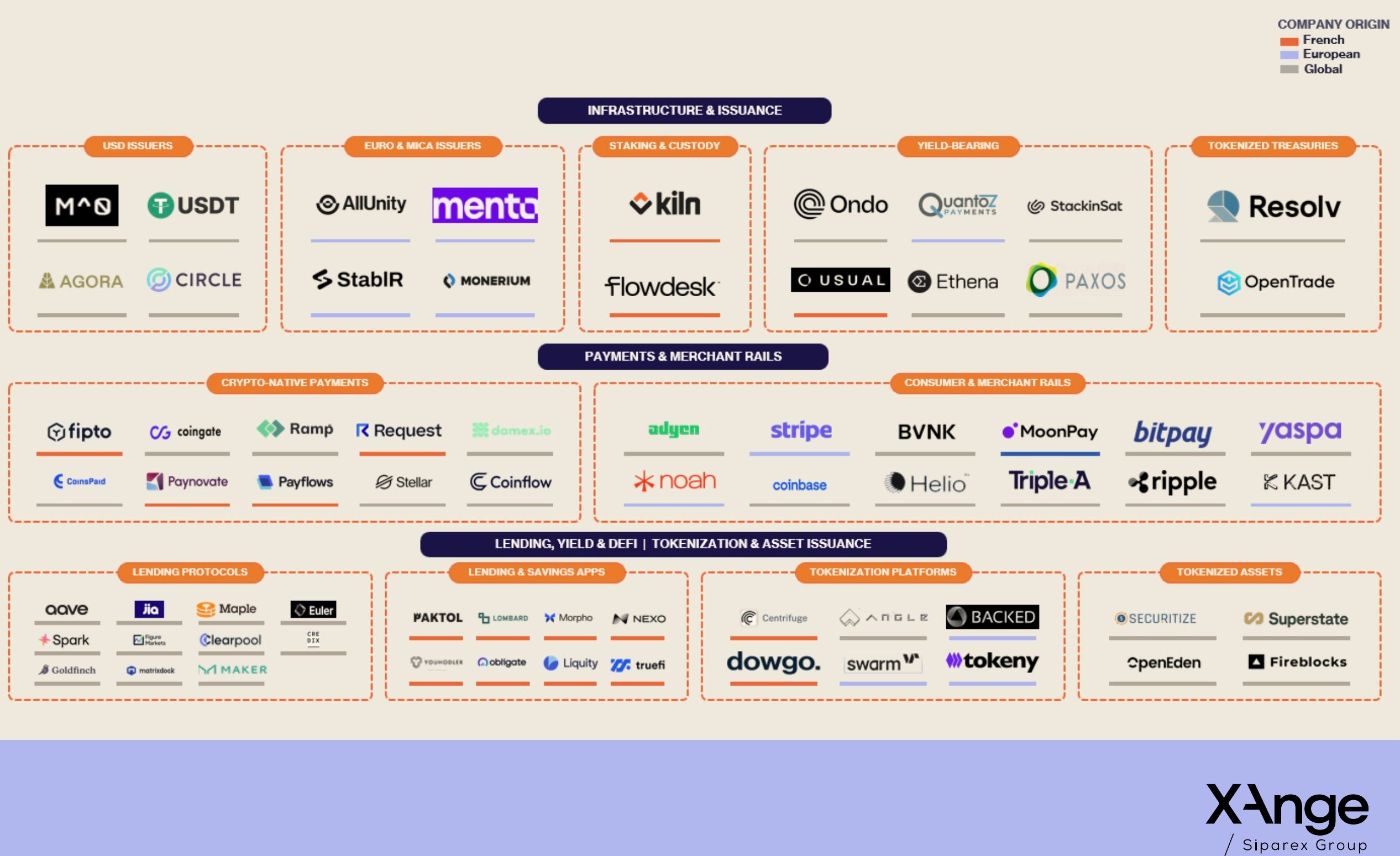
Three forces have converged in the last year and a half: the geopolitical environment has made stablecoins strategically necessary, the legal framework has gone from theoretical to operational, and the unit economics now beat the incumbent rails.
The geopolitical environment has changed. With the war in Ukraine entering its fifth year, the dollar openly weaponized through sanctions, and tariff escalation between the US, China and the EU, holding USD on a US bank rail is no longer a neutral choice for European corporates: it carries jurisdictional risk. In emerging markets where local currencies have lost 20 to 60% versus the dollar (Turkey, Argentina, Egypt, Nigeria), stablecoins have become a plausible savings instrument. The result is a structural pull on euro-denominated, MiCA-compliant stablecoins as a sovereign alternative to USD on-chain.
MiCA is no longer a theoretical framework, but a fully established system. Two years in, the first cohort (Circle EURC, SG–Forge EURCV, Monerium EURe, Angle agEUR) has been joined by AllUnity EURAU, StablR and Quantoz, all operating under EMI licenses from BaFin, the ACPR, the AFM and the CSSF. EUR stablecoin supply has grown roughly 5x since 2024, and for European corporates a euro stablecoin is now treated the same way as a euro IBAN. The US caught up in 2025 with the GENIUS and STABLE acts.
The use-case economics have flipped. Settlement on Ethereum, Solana, Base and Stellar is fast and cheap enough that a €50 cross-border transfer costs cents and settles in seconds. Tether, Circle and Paxos collectively manage over $250B in reserves yielding ~4.5%, which fuels their aggressive product expansion. On real corridors (EU–MENA, EU–LATAM), B2B settlement now clears at 30 to 80 bps versus 200-400 bps through correspondent banking. For a treasurer running weekly payroll, the switch pays for itself in one cycle.
Thanks for reading Fintech Wrap Up!
Disclaimer:
Fintech Wrap Up aggregates publicly available information for informational purposes only. Portions of the content may be reproduced verbatim from the original source, and full credit is provided with a “Source: [Name]” attribution. All copyrights and trademarks remain the property of their respective owners. Fintech Wrap Up does not guarantee the accuracy, completeness, or reliability of the aggregated content; these are the responsibility of the original source providers. Links to the original sources may not always be included. We use AI tools to brainstorm, draft, edit, and summarize, but the ideas, analysis, and connections Sam draws are his. Every piece is verified and written in Sam’s voice. For questions or concerns, please contact us at sam.boboev@fintechwrapup.com.