

Stripe just acquired OpenRouter for more than $7 billion, roughly five times the valuation OpenRouter carried three months ago. A payments company just paid a premium to own the layer that decides which LLM handles a request, at what cost, and with what fallback path. If you build fintech products on top of LLMs, this is no longer a developer tooling question. It is an infrastructure decision with the same weight as picking a payments processor or a core banking vendor.
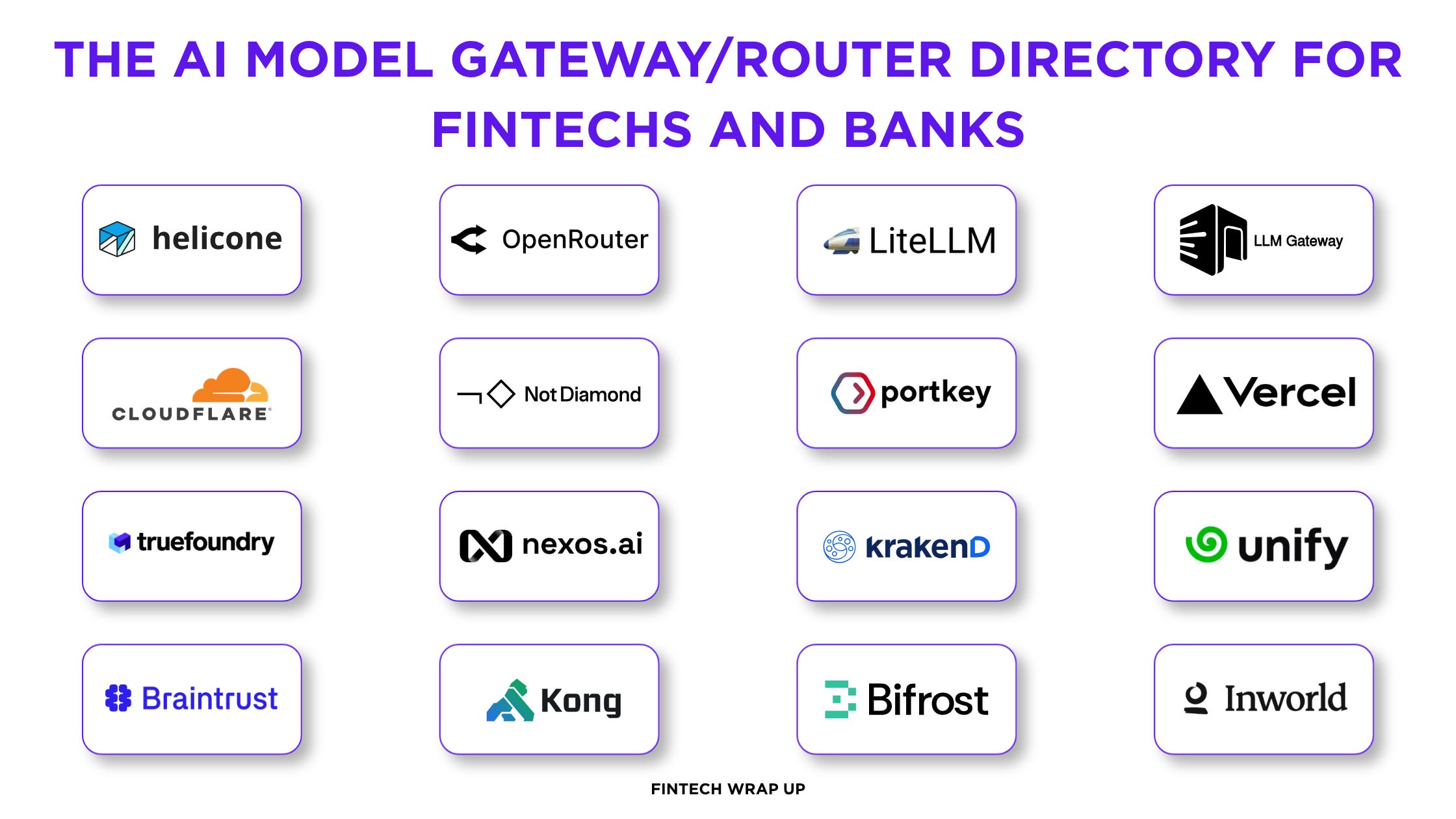
Stripe’s acquisition of OpenRouter turns AI gateways from a nice-to-have into infrastructure banks and fintechs need to evaluate seriously. This guide maps 16 AI gateway and LLM routing platforms across five categories, with the deployment models, compliance posture, and pricing structures that matter when you handle regulated data. I built it because most comparisons of this category are written for general SaaS teams, not for people who need to answer a compliance questionnaire before they ship. Structured profiles and a companion Excel file with seven filterable tabs are below the paywall. Use it to shortlist vendors before your next infrastructure review.
What this guide covers
I collected 16 companies in the AI gateway and LLM routing space, pulling data directly from official websites and public documentation. For each one I looked at what they do, how they deploy (SaaS, self-hosted, VPC, on-prem, hybrid), which LLM providers they support, their feature set across 13 production-relevant dimensions, their compliance posture (SOC 2, ISO 27001, GDPR, HIPAA, data residency), and their pricing model. Where a company did not publicly disclose something, I marked it “Not disclosed” rather than guess. The Excel file breaks this into seven tabs: Overview, Deployment, LLM Providers Supported, Features, Compliance and Security, Pricing and Funding, and a Master Table for filtering across every dimension at once.
The 16 companies, by category
General-purpose LLM routers
OpenRouter routes across 80-plus providers and 500-plus models, now under Stripe. Inworld Router uses conditional logic to route based on user context, zero markup. Unify AI has shifted toward agent workflows but still routes across major providers.
Enterprise and compliance-focused routers
Kong AI Gateway extends Kong’s API gateway into LLM and agent traffic. TrueFoundry AI Gateway supports VPC, on-prem, and air-gapped deployment. Nexos ai runs out of Europe with ISO 42001 and zero data retention options.
Cost-optimization routers
Not Diamond predicts the optimal model per request to cut inference cost while holding or improving accuracy, positioned heavily toward coding agents.
Open-source and self-hosted routing frameworks
LiteLLM is the most widely adopted open-source gateway. Maxim Bifrost offers a high-throughput OSS gateway plus enterprise option. LLM Gateway is AGPLv3-licensed with SaaS, self-hosted, and hybrid options. KrakenD extends its API gateway into AI routing with a free community edition.
AI gateway platforms with routing
Portkey combines a SaaS control plane with an optional self-hosted gateway across 1,600-plus models. Braintrust is primarily observability and evaluation with gateway-adjacent capability. Helicone pairs routing with LLM observability. Cloudflare AI Gateway runs on Cloudflare’s network with dynamic routing. Vercel AI Gateway offers zero-markup pricing and routes coding agent traffic too.
What’s behind the subscribe button
Subscribers get the full structured profile for all 16 companies, organized by category, covering what each company does, its exact deployment model, which LLM providers it supports, a feature-by-feature breakdown across 13 production-relevant capabilities, its compliance and security certifications, and its pricing model. You also get the companion Excel workbook with seven tabs for side-by-side comparison and filtering, plus a closing section on how to actually use this guide when running a vendor evaluation.
If you are choosing infrastructure that will sit between your product and every LLM call you make, subscribe to get the full comparison and the spreadsheet.