

This week’s fintech reports explore the rapid evolution of digital finance, highlighting growing stablecoin adoption in cross-border and business payments, APAC’s emergence as a leading stablecoin market, and the potential of tokenization to improve shareholder access, transparency, and efficiency. They also examine how banks must modernize their services, leverage AI while maintaining customer trust, and address the challenges of building stablecoin neobanks and secure agentic commerce. The Binance hack deep dive further highlights the risks of blockchain security, showing why pausing withdrawals alone is insufficient when malicious on-chain permissions remain active.
Video of the Week
Deep Dive of the Week
Why pausing withdrawals wasn’t enough in the $6.34 billion Binance hack

On 29 October, Binance paused customer withdrawals after attackers broke into its wallet infrastructure. The pause closed the route customers normally use to take money off the exchange. But the attackers had already given their own code permission to move assets from one of Binance’s Ethereum wallets. That permission was recorded on Ethereum. Binance needed a separate transaction on the blockchain to revoke it.
At 23:56 UTC, a transfer of 2,961.9 ETH that had already been broadcast became final. At 00:10 UTC, Binance cleared the malicious permission. The exchange estimates that $6.34 billion in assets were affected across several networks. Its account of how the attackers got in is preliminary.
For any bank or fintech using a crypto custodian, the incident raises a practical question. If the provider has to shut down its systems, who can revoke a permission that is already live on-chain?

This week’s reports
1️⃣Cross-Border Payments in the Americas
2️⃣The Banking Expectation Gap
3️⃣State of Stablecoins and Payments
4️⃣The Definitive Stablecoin Landscape Series
5️⃣What Tokenization Offers the Issuer
6️⃣How to build a stablecoin neobank
7️⃣Building Trust in Agentic Commerce
Cross-Border Payments in the Americas
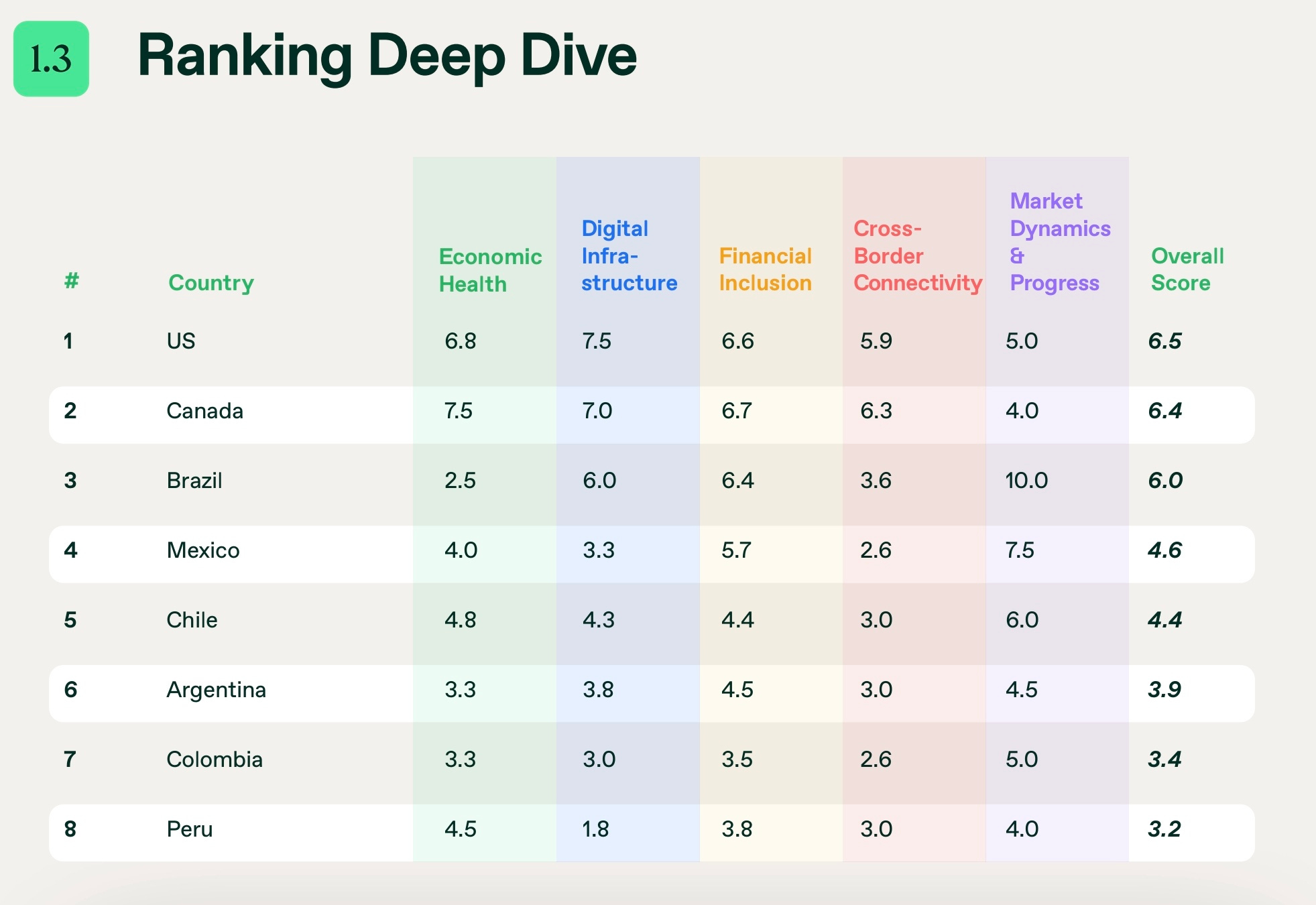
Interoperability is a critical factor in determining how effectively individuals, businesses, and financial institutions can participate in an increasingly globalised digital economy. This is represented through the Thunes Cross-Border Interoperability Index, which operationalises the ability individuals have to transact with businesses, and transfer money outside of their national systems.
Interoperability is often viewed solely through a technical lens, where the focus is on whether systems can exchange information and process transactions. In practice, it encompasses a broader set of more holistic considerations. Effective interoperability determines whether consumers can access services regardless of their preferred payment method and whether business can reach customers across borders without added complexity. Finally, the ability to integrate new payments innovations into existing financial infrastructure without creating unnecessary costs and friction is a key factor when building interoperability.
Achieving contextual interoperability involves curating an approach that adapts to the cultural and infrastructural realities of each market. In the US, this entails recognising the significant fragmentation around payment preferences in the international payments market. Many major global payment processors and digital wallets are based in the US, as well as fintech innovators such as BNPL and cryptocurrency services, which opens up significant choice for users. Taking this into consideration when building interoperability is vital to expanding access to fast, low-cost international payments delivered to the recipient’s account or wallet of choice.