

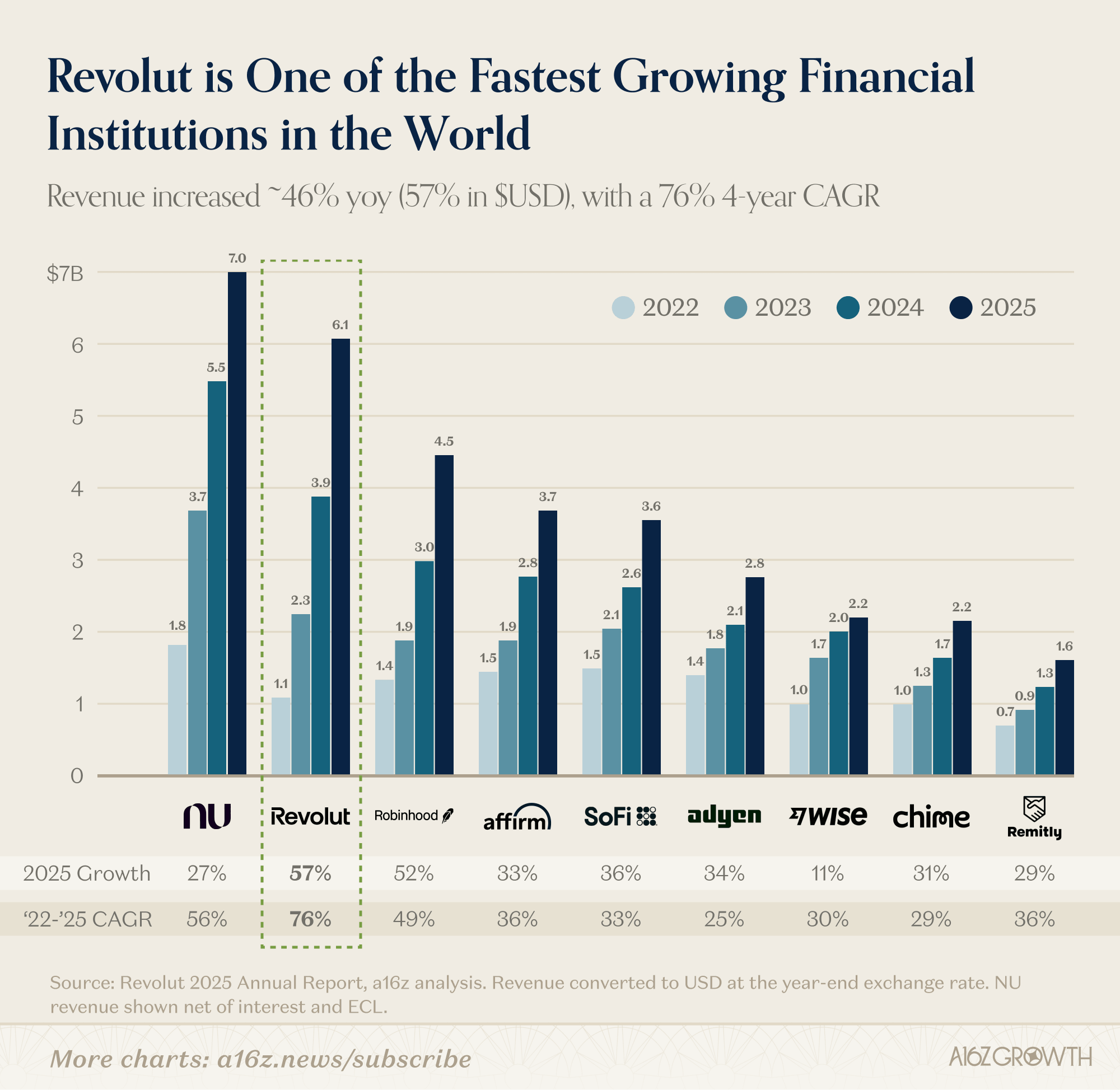
Did you read the “Algorithm That Keeps Compounding” case study by Andreessen Horowitz (a16z)? If not, do not worry; I did it for you. In this deep dive, I take analysis by a16z as the core, share my comments on what they got right, what was too optimistic, and what was missing. We have to admit the global consumer fintech market has transitioned from the loose capital era of customer acquisition at all costs to a mature phase defined by structural monetization, regulatory validation, and balance sheet efficiency. While many first generation neobanks struggle under margin compression, the performance metrics of Revolut stands different.
To understand how the compounding engine of Revolut works, we must look past the consumer-facing marketing and dissect the underlying growth algorithm:

This formula is supported by a highly diversified six-segment revenue matrix, an asset-light core architecture, and an operating structure that decouples scale from operational headcount. This deep dive deconstructs these mechanisms, providing a strategic blueprint for fintech founders, product managers, and payments strategists operating in 2026.
Deconstructing the “Users × ARPU” formula
At the heart of the scaling model lies a dual-engine architecture designed to expand customer reach while simultaneously driving multi-product penetration. During the fiscal year ending December 31, 2025, group revenue grew 46% year-on-year to £4.5 billion, while profit before tax surged 57% to £1.7 billion, representing an elite profit before tax margin of 38%.
In software and technology investing, the Rule of 40 serves as the benchmark for elite operational efficiency. In our analysis of this compounding model, we observe a performance that operates on a completely different scale: the Rule of 75%. Calculated by combining the 46% revenue growth rate with a 29% net profit margin (derived from a net profit of £1.3 billion on £4.5 billion in revenue), the compounding speed places it in the highest tier of global financial institutions.
This compounding velocity is reflected in a Return on Equity of 35%.1 This capital efficiency is achieved despite massive overcapitalization, as total CET1 capital resources reached £2.6 billion.1 Traditional retail banks struggle to generate an ROE above 12% due to legacy physical branches, heavy human operational layers, and localized capital constraints. The company achieves its premium ROE by maintaining a completely branchless digital footprint and utilizing a viral peer-to-peer transaction network.
With 16 million new retail customers added in 2025 alone, bringing the total base to 68.3 million, approximately 70% of new sign-ups were acquired organically or through peer-to-peer referral loops. This referral system lowers customer acquisition costs to near-zero levels.
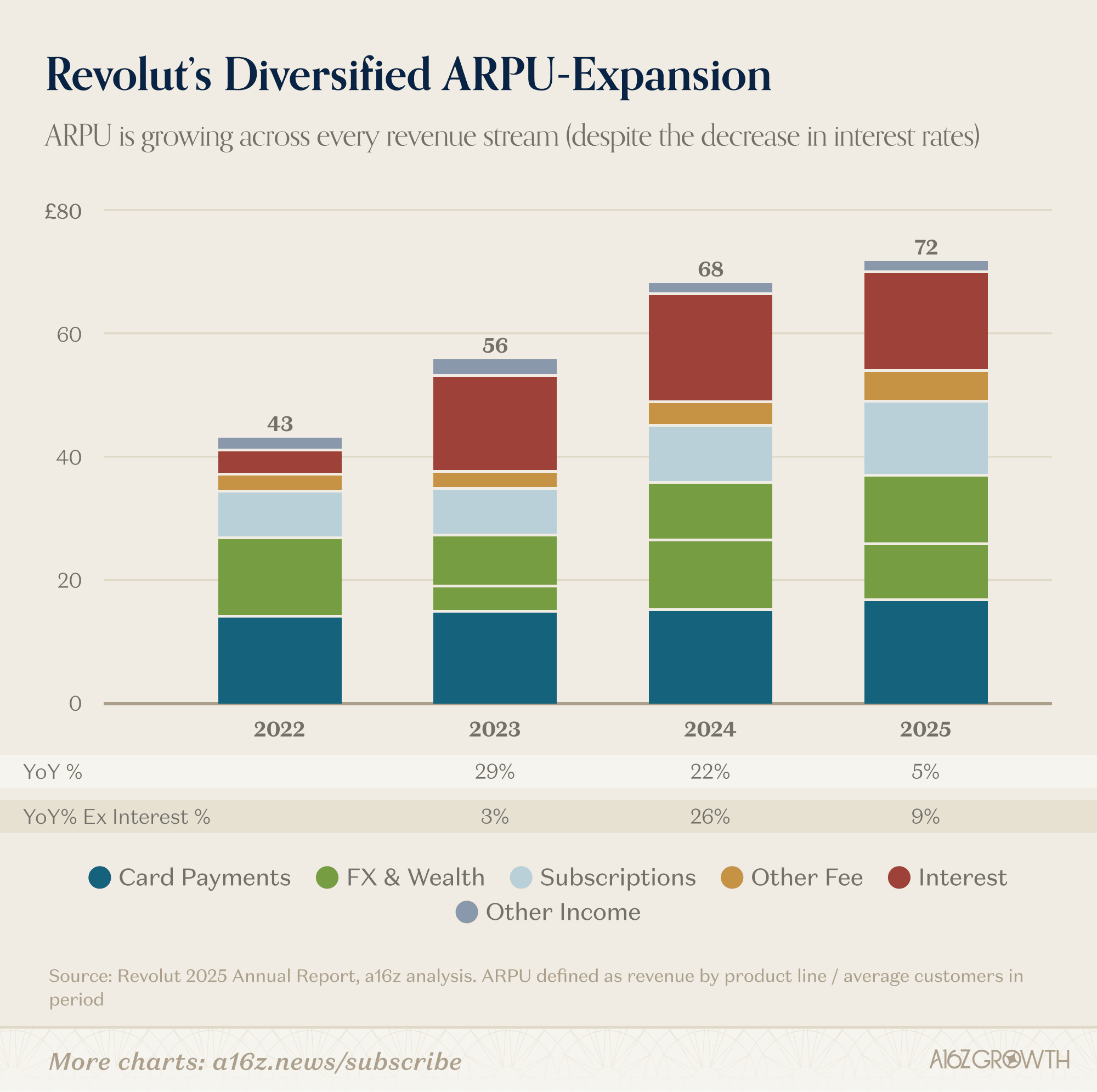
This organic reach provides the customer volume required to execute the average revenue per user expansion engine. Since 2022, overall ARPU has compounded at an 18% CAGR. This expansion is not dependent on a single asset class or lending product. Instead, it is driven by a highly diversified product matrix that distributes monetization across payments, interest, subscriptions, wealth, and foreign exchange.