

The global payments landscape is undergoing a structural transition as on-chain fiat instruments move from speculative retail instruments to institutional settlement rails. This shift is marked by two major infrastructure initiatives: the June 30, 2026, announcement of Open USD, denoted as OUSD, a shared stablecoin network backed by a consortium of over 140 corporate signatories, and the planned launch in the first half of 2027 of a tokenized deposit network operated by The Clearing House, which is co-owned by the largest commercial banks in the United States.
Led by Open Standard, an independent company, OUSD presents a collaborative, partner-governed model that directly challenges the traditional single-issuer structures of Tether and Circle. Led by founding Chief Executive Officer Zach Abrams, who previously co-founded the stablecoin infrastructure provider Bridge (acquired by Stripe for 1.1 billion dollars in 2025), Open Standard aims to realign the underlying economics of the stablecoin float. This analysis evaluates the architectural design of Open USD, compares its regulatory posture with Facebook’s defunct Libra project, assesses its competitive positioning against the USDC-USDT duopoly, and contrasts its utility against the banking sector’s emerging tokenized deposit networks.
The Genesis and Mechanics of Open USD
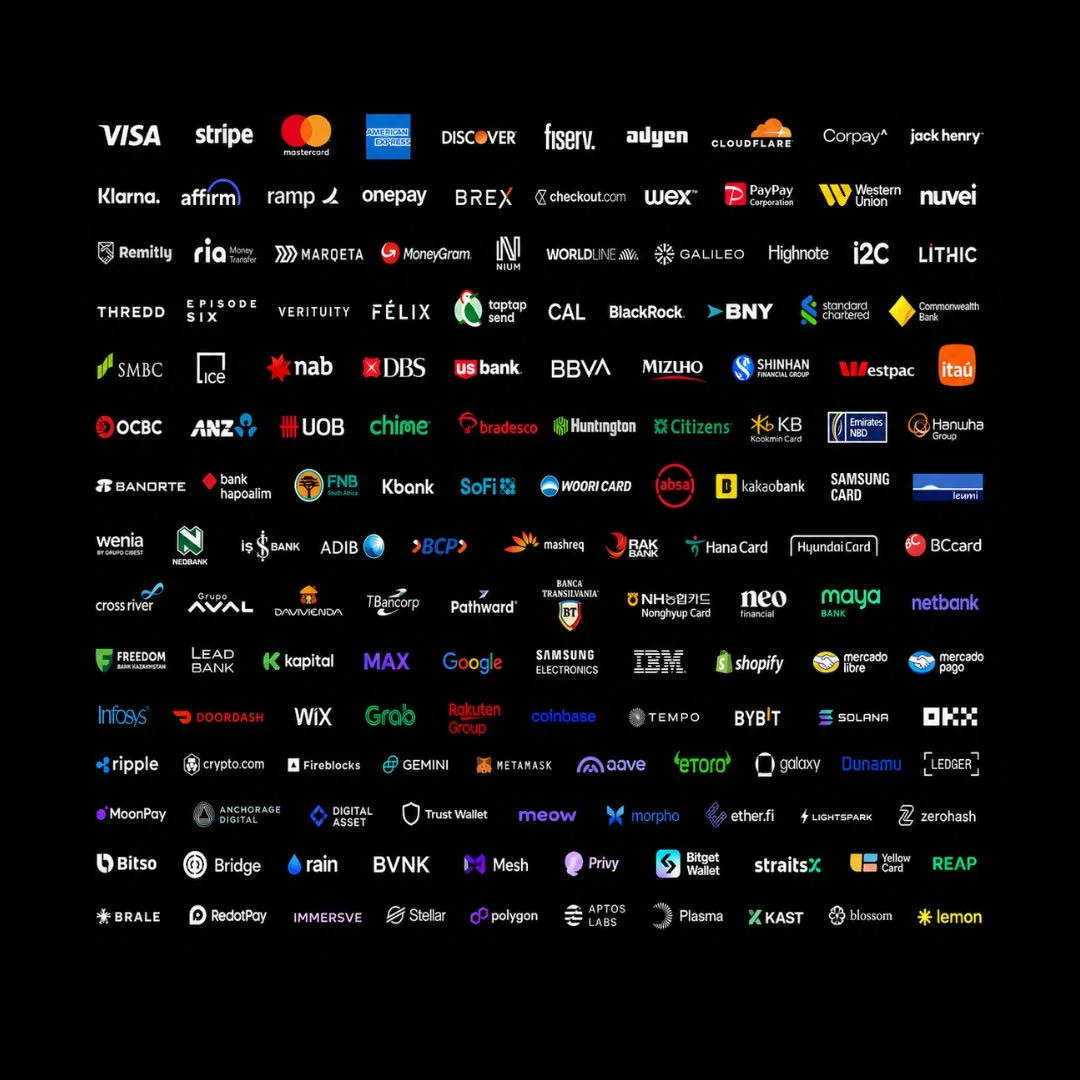
Open USD is engineered as shared payment infrastructure rather than a proprietary commercial product. The initial signatory roster spans payments networks including Visa, Mastercard, American Express, and Discover; financial institutions such as BNY, BlackRock, Standard Chartered, and DBS; tech giants Google, IBM, and Samsung Electronics; and crypto platforms Coinbase, Solana, Base, and Aave. The breadth of this alliance reflects a consensus that scaling stablecoins for global workloads requires open, low-cost, and aligned infrastructure. Stripe’s corporate leadership has indicated that OUSD will serve as the default stablecoin for businesses running on Stripe, while BNY executives project that the stablecoin market could scale to 1.5 trillion dollars by 2030.
The protocol operates on three primary operational mechanics: zero-cost transactional paths, partner-level reserve distribution, and consortium governance.
Traditional stablecoin models restrict minting and redemption to select institutional partners, often applying tiered fees, volume limits, or clearing delays through proprietary banking networks. Open USD eliminates these transaction-level costs. Under the Open Standard model, participating businesses can deposit fiat dollars and receive OUSD tokens onchain, or redeem tokens back to physical fiat at par, with zero minting or burning fees and no artificial volume caps. By removing transaction friction, Open Standard seeks to incentivize high-volume corporate treasury operations, merchant settlement, and cross-border routing.
The second mechanical departure is the distribution of reserve earnings. Traditional issuers manage backing assets (cash and short-duration Treasury bills) and retain 100 % of the interest income. At high interest rates, this model generates exceptional profitability for the issuer, while the distributors and integrations that drive token adoption receive no direct financial upside.
Open USD inverts this model: all interest income generated by the underlying reserves is pooled by Open Standard. After deducting a small management fee to fund compliance, technical operations, and custody fees, the remaining yield is distributed back to the partner network. This structure transforms onchain dollars into a productive asset for payment processors, exchanges, and merchant acquirers.
The distribution of yield to consortium partners can be represented as:

In this equation, Rpartner represents the net yield routed back to the participating partner network, Rgross is the gross yield earned on the underlying reserve assets, and Cmanagement is the operational cost deduction retained by Open Standard.
The third mechanic is the collaborative governance model. Open Standard operates as an independent company whose board is drawn directly from its partner base. Material decisions, such as reserve policies, custodian and auditor selection, chain expansions, and blocklisting, are decided by a partner-led board rather than a single corporate issuer. This collaborative oversight provides the operational neutrality necessary for competing financial institutions to settle on a single shared rail.
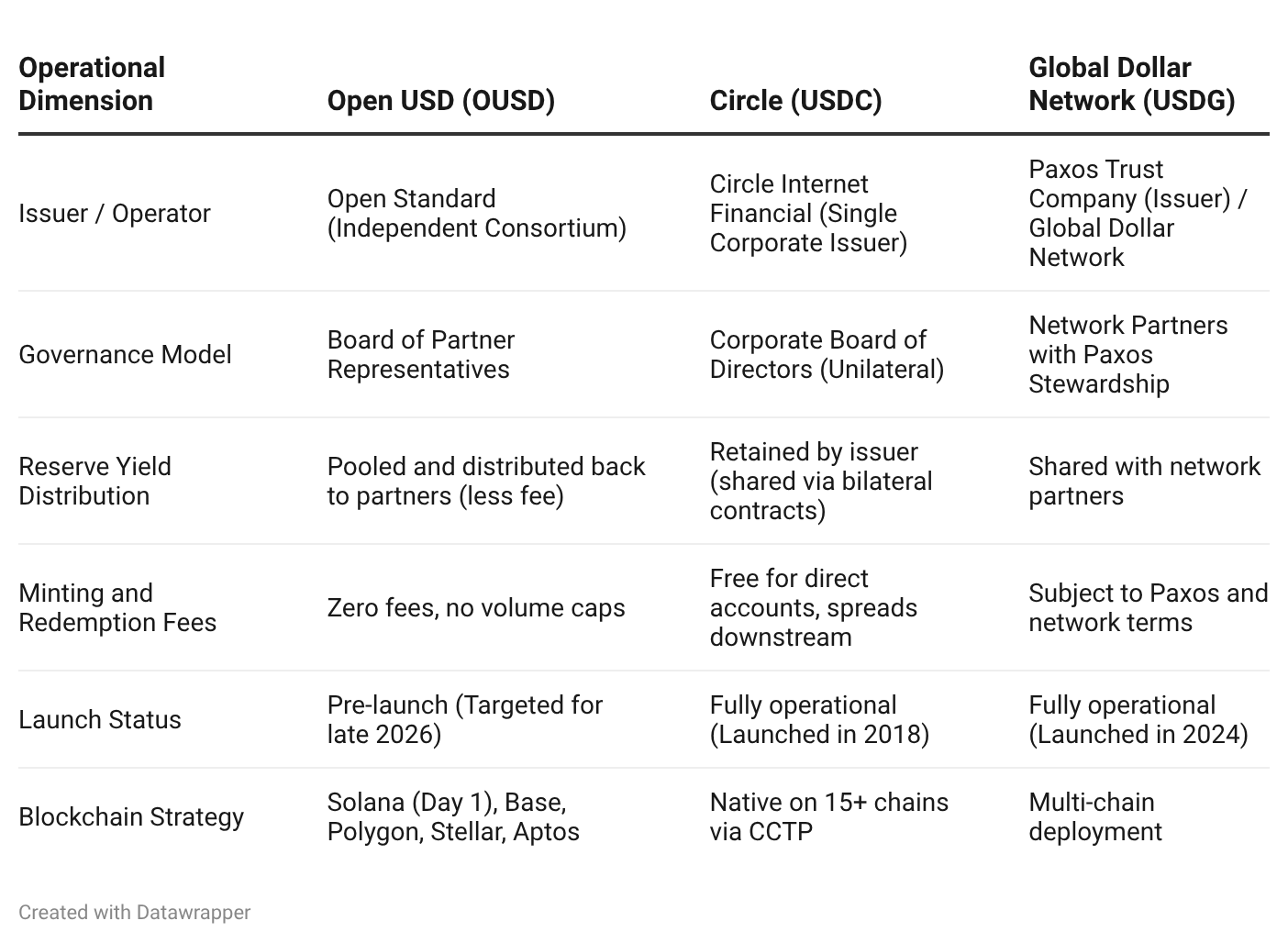
OUSD is engineered as an onchain token. The platform will launch natively on Solana and Base, with subsequent rollouts planned for Polygon, Stellar, Aptos, and Stripe’s Tempo infrastructure. Furthermore, its integration with Aave (the largest onchain lending market) and institutional custody networks like Fireblocks ensures immediate ecosystem utility upon deployment.