

If you run a software enterprise building generative AI applications today, your CFO spends far more time tracking GPU inference bills than traditional server expenses. Every user prompt hits upstream model providers, consumes tokens, and generates variable infrastructure costs. Meanwhile, your product team balances prepaid credits, usage thresholds, and multi-jurisdictional tax compliance across dozens of countries.
Back in 2021, solving this problem required connecting separate vendors for card processing, meter tracking, tax engines, and API routing. Today, this operational and financial workflow sits within Stripe’s expanded product stack.
What Stripe Already Was in 2021
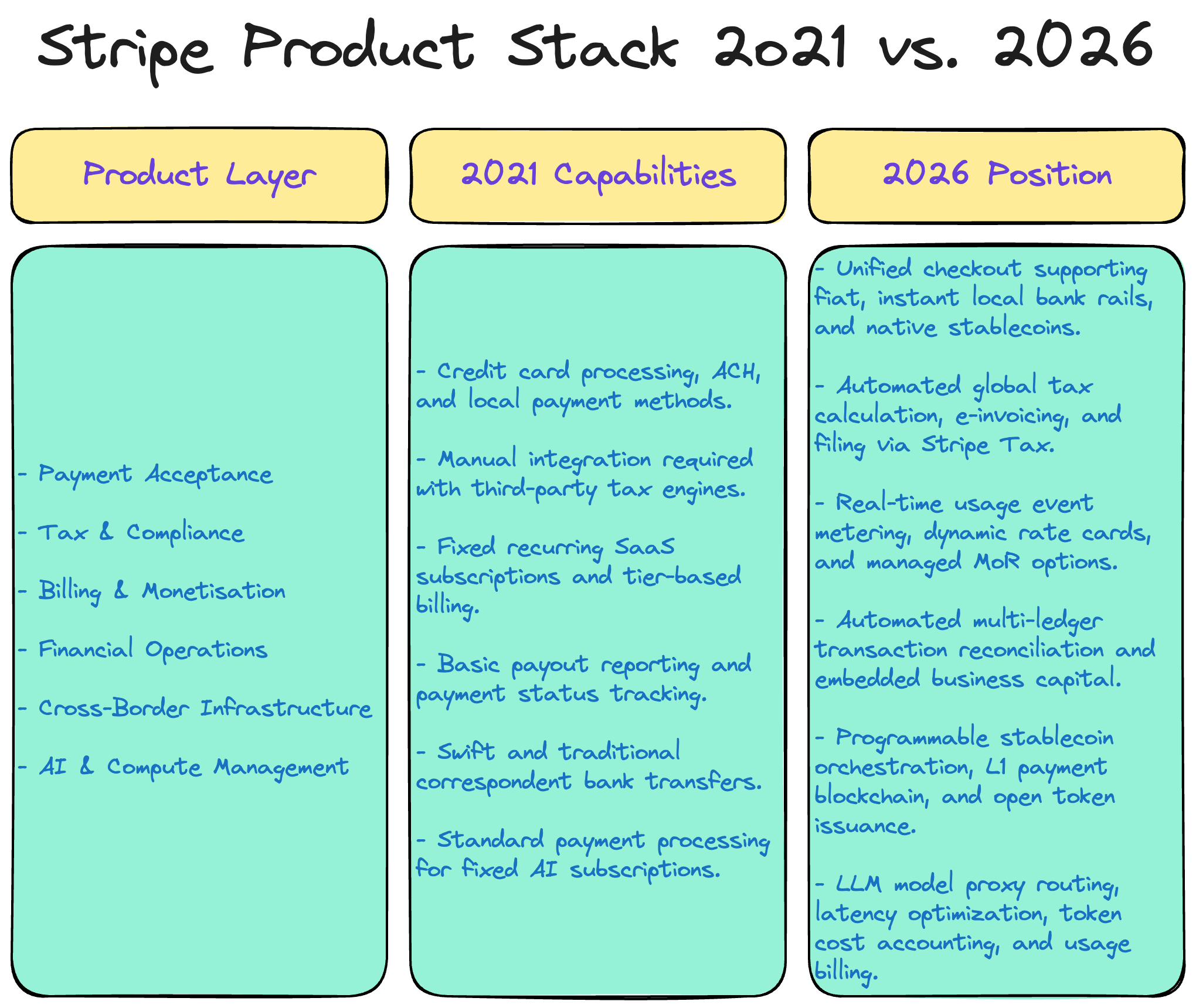
Understanding this transition requires establishing an accurate baseline. By 2021, Stripe was far more than a basic payment acceptance gateway. Its core ecosystem included Stripe Billing for subscriptions, Stripe Connect for marketplace payout routing, Stripe Radar for fraud prevention, Stripe Issuing for card creation, and Stripe Treasury for embedded banking services.
Software companies relied on this stack to accept online payments, split revenue between platforms, and manage fixed recurring billings.
However, major operational friction points remained difficult for internet businesses:
Tax Compliance: Calculating and remitting sales tax, VAT, and GST across thousands of local jurisdictions required complex external software integrations.
Financial Reconciliation: Matching transactions between internal application ledgers, payment gateways, and third-party bank accounts required heavy manual engineering.
Merchant of Record Overhead: Digital product creators lacked turnkey options to delegate legal selling liabilities, chargeback risks, and global tax filings.
High-Throughput Metering: Standard billing systems struggled to ingest and calculate millions of real-time usage events for usage-based software.
Cross-Border Transfers: Moving money internationally remained bound to slow correspondent banking rails, creating clearing delays and transfer fees.
Embedded Credit: Platform merchants needed access to working capital without navigating slow traditional bank underwriting channels.
The Acquisition Spree
In the past several years, Stripe closed several targeted acquisitions to expand its operational footprint beyond payment processing.
Early acquisitions targeted tax compliance and back-office reconciliation. In April 2021, Stripe acquired TaxJar to launch Stripe Tax, embedding automated tax calculations directly into checkout flows. In October 2021, Stripe acquired Recko to automate complex ledger matching across internal databases, processors, and bank statements.