

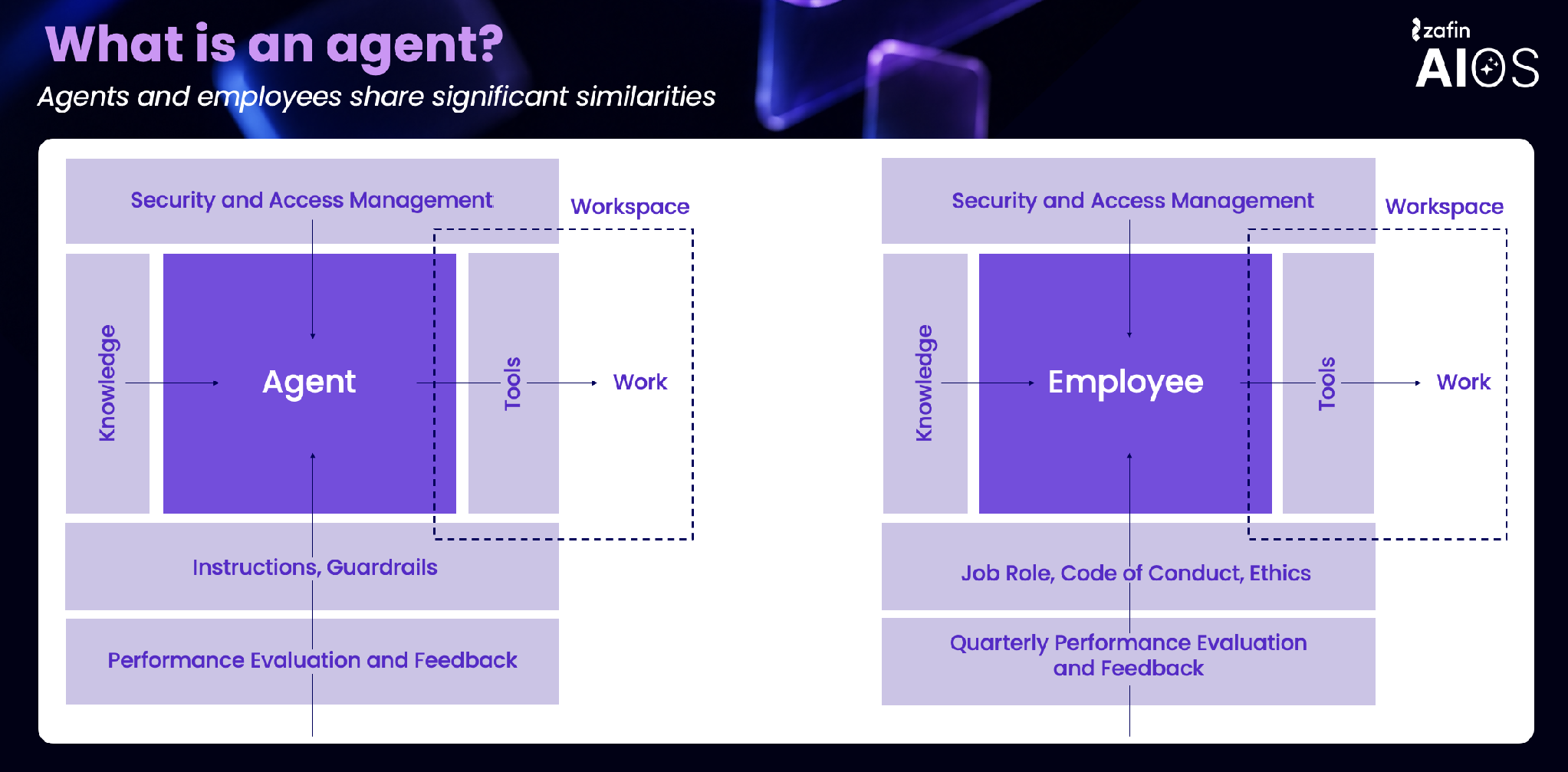
Banks often fail to derive meaningful value from AI because they tend to layer sophisticated automation on top of rigid, inefficient legacy workflows. While billions are spent on advanced tools, the actual impact remains minimal as these applications merely mask manual bottlenecks like compliance and security checks rather than resolving the underlying structural flaws. Consequently, achieving true operational progress depends on fundamentally redesigning core processes to integrate with AI, rather than simply deploying assistants to accelerate outdated habits.
To convert localized productivity into a scalable organizational resource, banking institutions must transition to governed agentic work. This shift requires a centralized control plane that decouples core business logic from individual model providers. This article details the technical implementation, system topology, and security parameters of an end-to-end agentic operating platform, utilizing Zafin AIOS as the architectural reference model
From individual assistants to governed systems
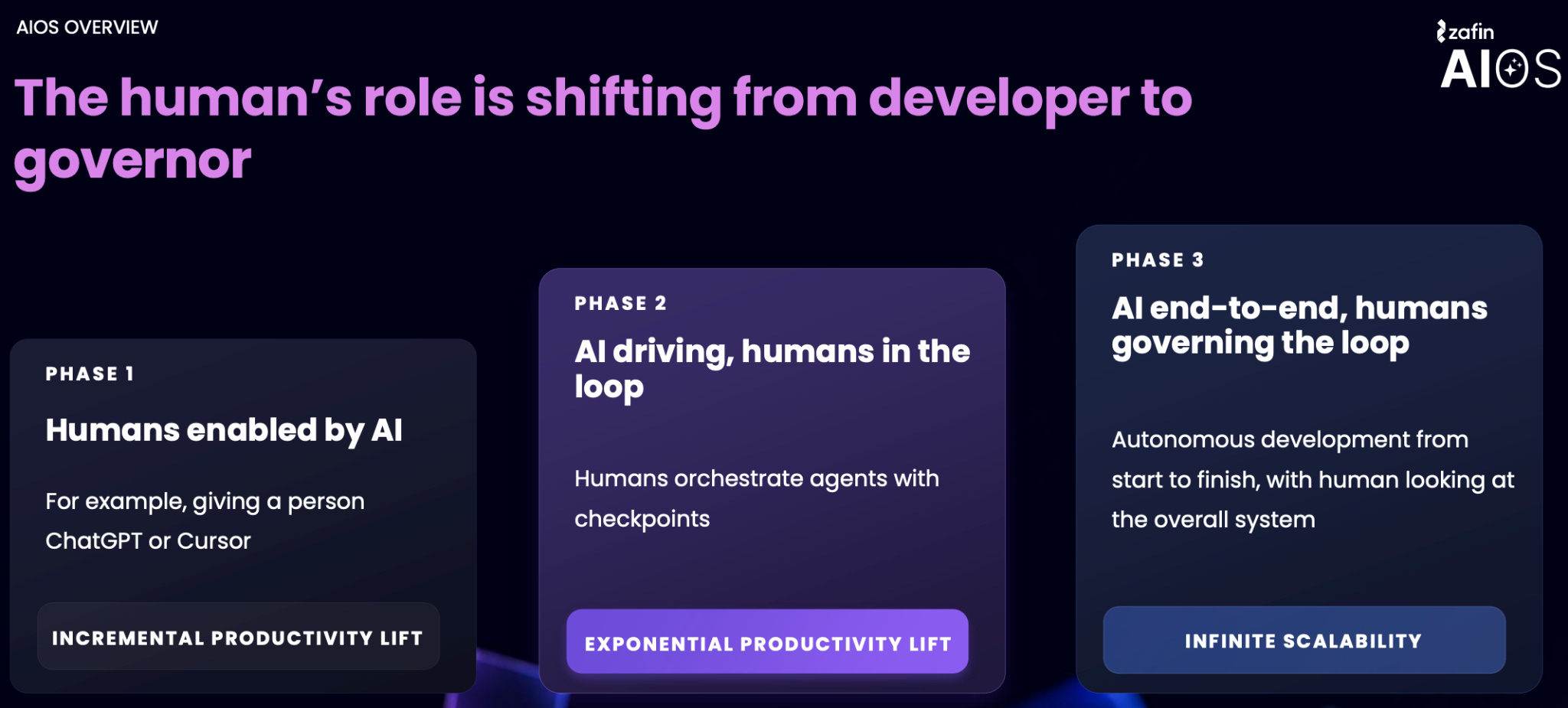
The integration of artificial intelligence inside financial institutions moves through three distinct operational phases, beginning with humans operating alongside generic chat interfaces for localized productivity lifts. This evolves into automated task pipelines where agents execute processes with human-in-the-loop validation to manage escalating coordination overhead, ultimately reaching a mature state of fully governed operations. In this final phase, autonomous agents manage complete end-to-end system lifecycles while human focus shifts to setting policies, reviewing systemic exceptions, and validating immutable audit trails.
In Phase 1, humans operate alongside generic chat interfaces or local code completion utilities. This pattern yields a localized, non-scalable productivity lift.
Phase 2 introduces automated task pipelines where agents execute processes with human-in-the-loop validation. This architecture delivers exponential productivity gains but introduces coordination overhead as the number of parallel tasks escalates.
Phase 3 establishes fully governed operations. In this mature state, autonomous agents manage complete end-to-end system lifecycles while humans focus on setting policies, defining boundaries, reviewing systemic exceptions, and validating immutable audit trails.
Deploying Phase 3 operations in highly regulated banking environments requires an orchestration platform that acts as an enterprise operating system. Zafin AIOS implements this conceptual kernel, solving the structural vulnerabilities of ad-hoc multi-agent fleets: context fragmentation, scheduling conflicts, lack of environment isolation, and inconsistent tool input/output protocols.
Architecture of the agentic orchestrator
The Zafin AIOS architecture functions as an operating system kernel that sits between the developer-facing application layer and the underlying model endpoints, database engines, and software-as-a-service platforms.
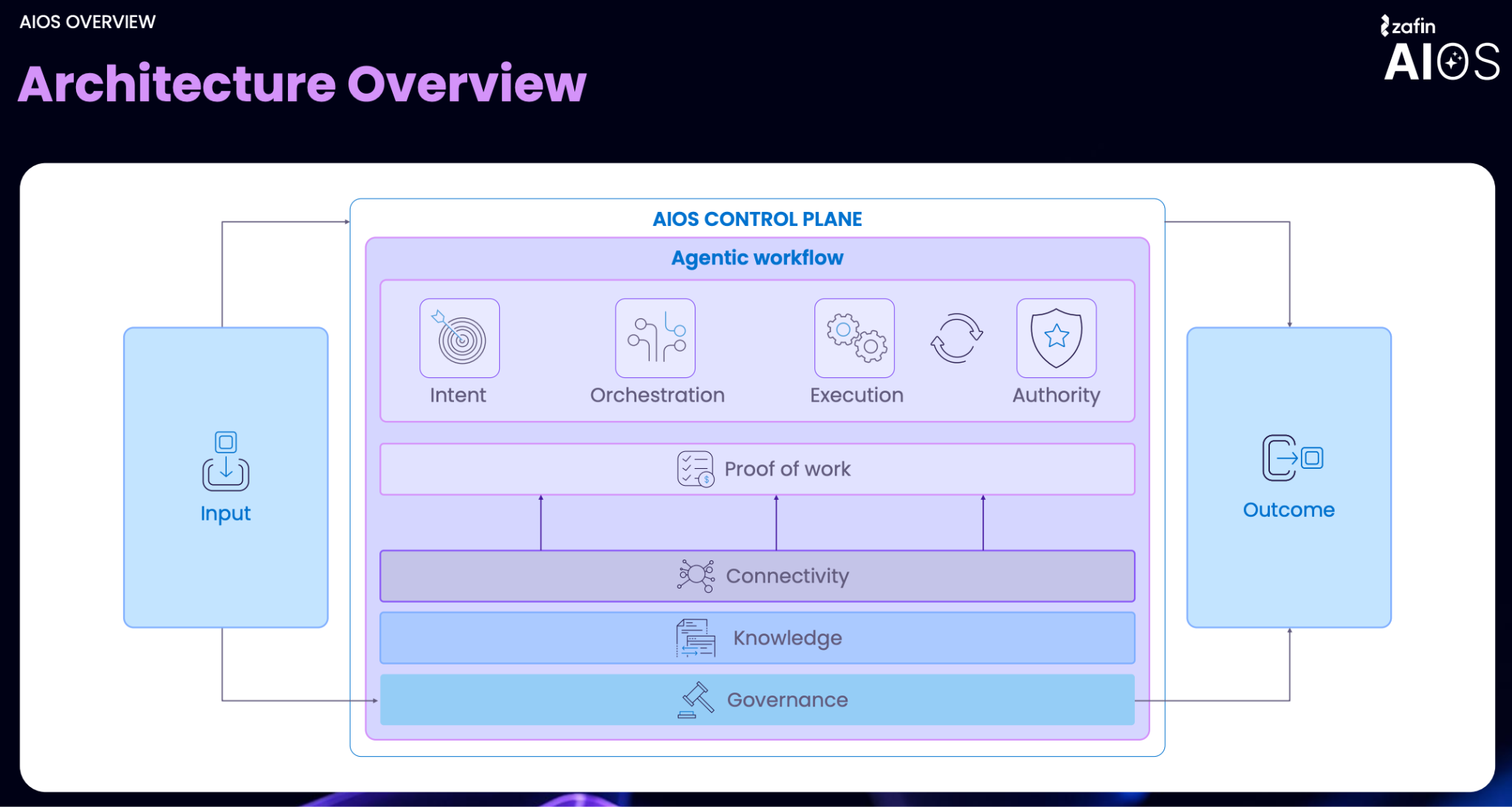
The system organizes agentic work through five primary control layers.
1. The core layers
The platform coordinates operations by dividing system responsibilities into dedicated structural domains.
Work layer (Agent Work Management): Manages the complete lifecycle of tasks, moving cases through multi-step workflows, tracking active states, and persisting execution context.
Agents layer (Agent Config Management): Configures and manages the profiles, permissions, compute constraints, model guidance configurations, and identity parameters of synthetic workers.
Compute layer: Provisions and manages isolated physical or virtual compute runtimes across public cloud, private cloud, or on-premises server infrastructure for agent execution.
Control layer: Manages continuous system orchestration, real-time logging, LLM traces and audit logs including prompts, inputs, and outputs, token and compute cost tracking, and work item analytics.
Evaluations layer: Executes automated testing, benchmark comparisons, drift detection, knowledge poisoning detection, and LLM-as-a-judge review cycles.
2. The internal agent kernel structure
Within Zafin AIOS, a running agent instance functions as a structured runtime containing dedicated service interfaces rather than a simple script calling a public model API.
Connected directly to the Platform Agent Config Management database to sync current system rules, the Agent Instance houses a core AIOS Agent Orchestrator. The AIOS Agent Orchestrator requests work from the AIOS Agent Work Management module when it is idle.
Communication with external platforms occurs through a Cross-Harness Interface, which allows engineers to plug in optimized agent harnesses like Claude Code or Codex via pluggable CLI harnesses without rebuilding the underlying runtime.
The AIOS Agent Gateway provides agents with a unified, governed access layer for both models and tools. It connects agents to approved tool environments through the Model Context Protocol (MCP), while routing model requests directly to frontier AI providers such as Anthropic and OpenAI, through enterprise platforms such as Microsoft Foundry and Databricks Unity AI Gateway, or to self-hosted models served using vLLM or Ollama. All connections flow through controlled egress paths to preserve network isolation.
Agent identity and access management
To strengthen security and compliance in banking environments, Zafin AIOS assigns each autonomous agent a distinct, governed digital identity with least-privilege access, auditable activity, and lifecycle controls. This applies workforce-grade identity and access management to multi-agent workflows while reducing the risks associated with shared administrative accounts and generic API keys.
Directory-level identity integration
Every agent in Zafin AIOS is onboarded through the bank’s active corporate directory system (such as Active Directory or LDAP) and possesses a verified email address, system credentials, and a device management profile. This ensures that security teams can provision, audit, or revoke agent permissions using the exact same access-governance tooling used for human staff.
Zero-trust and least-privilege access profiles
Agents inherit default role-based access control guidelines, requiring explicit profile configurations that serve as dynamic boundaries for corporate resource access. These profiles define critical operational parameters, including compute constraints like hardware and network specifications, knowledge access limits for specific document or code bases, and tool entitlements that govern API mutations and database writes. Additionally, they establish workflow permissions to restrict execution paths to authorized tasks, such as bug reproduction or log analysis, ensuring a secure and governed environment.
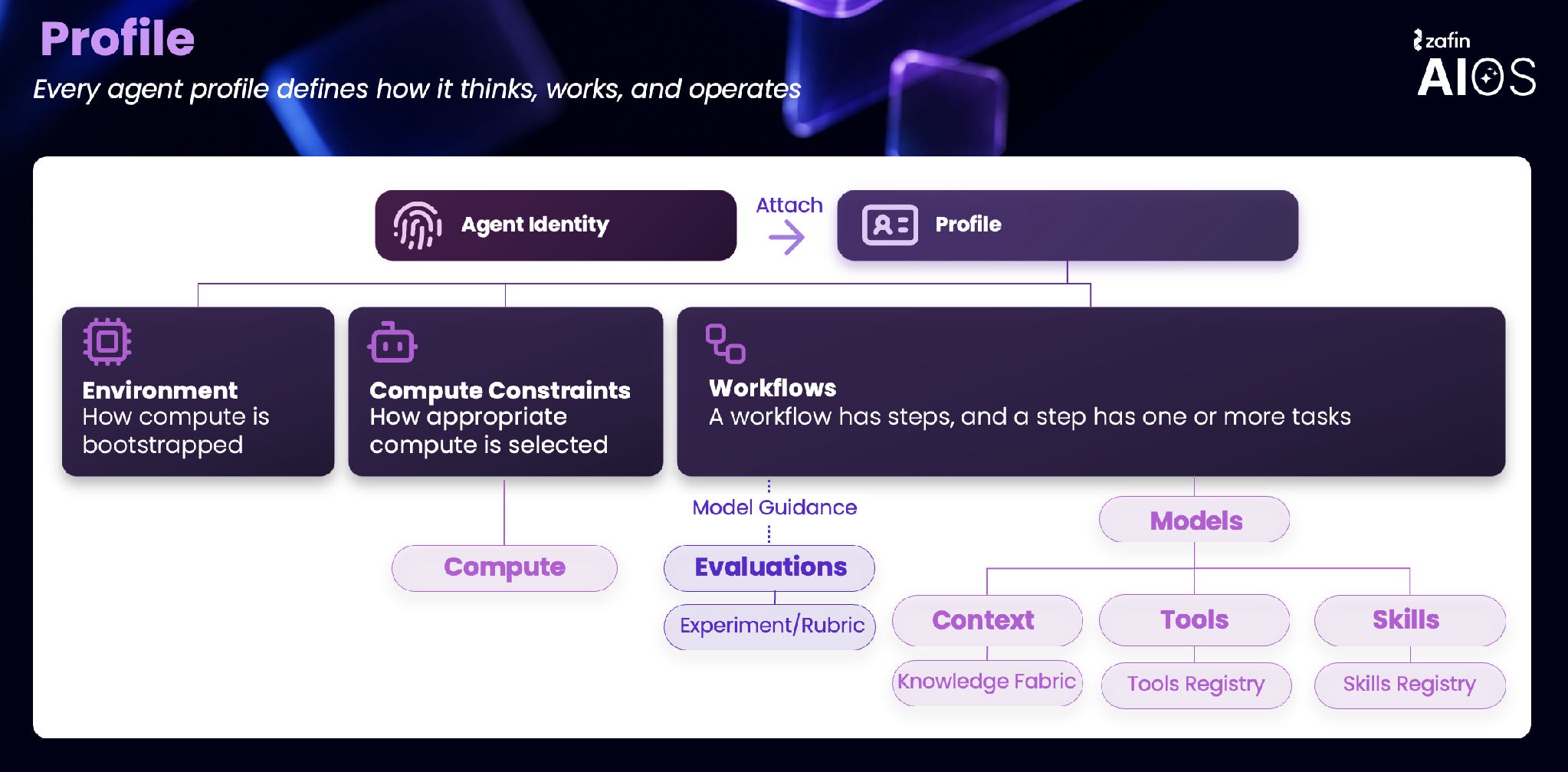
When an agent changes operational roles, its previous configurations are entirely wiped from the active instance. This ensures that the system enforces least-privilege design rules and prevents privilege escalations during long-running multi-agent processes.
AIOS Agent Knowledge Fabric and drift mitigation
To prevent hallucinations and secure access to the system parameters, policy documentation, code libraries, and database schemas required in complex corporate and investment banking environments, Zafin AIOS utilizes an integrated Knowledge Fabric.
Multi-database grounding layer
The Knowledge Fabric coordinates three distinct database paradigms to support diverse information requests. It utilizes a relational database to store structured transaction schemas, system configurations, document hierarchies, and case history metadata, providing a foundation for organized data management. Complementing this, a vector layer operates semantic embedding indexes to run retrieval-augmented generation pipelines across unstructured corporate policy PDFs, technical runbooks, and historical support records. Finally, a graph system maps systemic relationships, codebase dependency graphs, and regulatory cross-references, ensuring the preservation of structural context across deep operational hierarchies.
Mitigating context poisoning and model drift
A major vulnerability in multi-agent environments is context poisoning, which occurs when incorrect outputs from an active agent are saved back to the database and contaminate future context retrievals. Zafin AIOS mitigates this risk by forcing agents to compile completed tasks into structured case studies.
The platform routes these case studies to an independent LLM-as-a-judge validation engine rather than automatically writing them to the active knowledge base. This engine verifies the document for factual consistency and ensures the resolution aligns with programmatic baseline expectations.
To protect the system from long-term logic regressions, the platform runs scheduled drift detection experiments. These experiments retrieve historical operational scenarios, execute them across multiple local and proprietary model endpoints, and compare the outputs with validated golden-record baselines. This ensures that changes to the knowledge base, model updates, or upstream system modifications do not introduce logical drift or systemic errors.
Connectivity
Connecting autonomous agents directly to enterprise databases, internal transaction ledgers, and third-party SaaS platforms creates complex integration challenges. Ad-hoc API connections demand complex security protocols, specialized error-handling, and unique database adapters.
Zafin AIOS normalizes these systems through a central Tools Registry built around the Model Context Protocol (MCP). MCP functions as an open standard, allowing agents to access diverse software environments through unified server interfaces.
Using MCP simplifies tool integration across the ecosystem. By hosting tools as localized MCP servers, the control plane can enforce standardized auth scopes, error validations, and output protocols. This ensures that agents interact with underlying databases through secure, standardized interfaces, protecting core transactional systems from unguided database mutations.
AIOS Agent Work Management
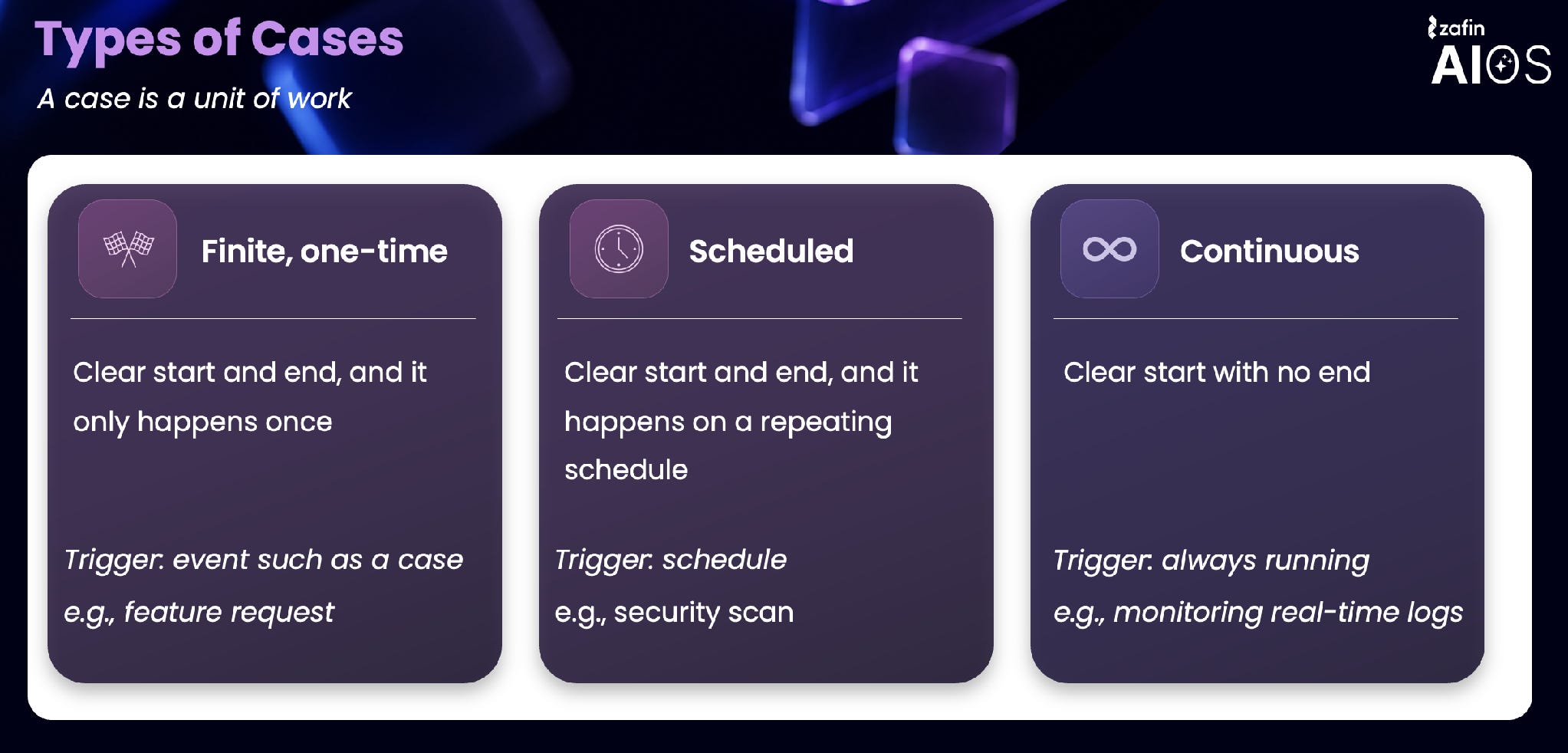
The execution layer of Zafin AIOS centers on Agent Work Management (AWM), an orchestration engine that manages, schedules, and tracks work items, which are defined as bounded units of work with clear objectives. Rather than treating all tasks identically, the platform organizes work into three distinct operating schedules based on their temporal requirements and scope. Finite work represents standalone processes with defined boundaries, such as modernized code sequences or transaction error triaging, while recurring workflows like weekly vulnerability scans are handled as scheduled cases on a preset calendar. For environmental monitoring and real-time anomaly detection in production logs, the system utilizes continuous work as always-on runtimes, ensuring that every variety of business intent is supported by a specialized execution model.
When an agent becomes idle, it requests work from the AWM engine. AWM recognizes the agent and its associated profile, including its capabilities and the types of work it is authorized to perform. Based on this information, AWM selects and assigns an appropriate work item to the agent.
As the agent executes tasks, the AWM engine tracks state transitions, manages error recovery, and reports active telemetry to the Control Tower. If an agent runs into an operational error or fails to meet a validation gate, the platform routes the task to a coach-and-retry gate, prompting a human operator to step in, provide guidance, and resume execution without restarting the parent work item.
The model gateway
Because frontier model APIs are priced dynamically based on input and output token consumption, running unmanaged multi-agent loops can quickly result in unpredictable computational bills. Zafin AIOS implements an Agent Gateway that acts as a centralized model router and security proxy, decoupling execution requests from specific upstream providers.
The AIOS Agent Gateway enables organizations to use the right model for each task at the appropriate cost point, recognizing that no single model is best suited to every workload. AIOS Evaluations assesses candidate models against task-specific rubrics, and the results inform model selection and configuration. Tasks containing sensitive information are routed to models running on bank-hosted GPUs, while other workloads can use managed or frontier models when their capabilities, performance, and cost are a better fit.
The platform’s Control Tower tracks telemetry for every model call, compiling trace logs that show exact duration metrics, token counts, and costs for every step of a work item. This ensures that bank operators can identify logic loops, locate inefficient model calls, and manage active compute budgets from a single operating dashboard.
Proof of work
Deploying autonomous agents in regulated financial environments requires robust audit processes. Relying on simple post-event text logs is insufficient for compliance validation. Zafin AIOS implements a “proof of work” verification architecture that establishes a secure, chronological, and immutable record of every workflow step.
This verification process ensures that the system records exactly:
What was requested and how the platform interpreted the business intent.
What specific profiles, models, and tools were active.
What context files and database queries were retrieved.
What LLM models were used, prompts, inputs, and outputs.
What screens looked like during execution via automated video capture.
Where and when human reviews occurred in the execution chain.
This comprehensive record travels alongside the work artifacts, giving compliance and audit teams a complete, defensible review trail. This reduces the need for manual post-event audit reconstruction, helping banks meet strict regulatory and compliance guidelines.
Measuring operational performance
To demonstrate the capabilities of the Zafin AIOS platform, the system was validated internally across software development and business operations.
The platform’s performance was tracked across key enterprise metrics.
These results show that establishing a structured control plane turns experimental AI tools into a measurable enterprise operating resource. This architecture enables financial institutions to tackle deferred technical debt, system modernizations, and compliance tasks that were previously too expensive to run with manual engineering resources rather than strictly focusing on head-count reduction.
For banking executives, deploying an end-to-end orchestration platform is a critical infrastructure requirement. While institutions can consume various models from different providers, they must build the internal operating runway and control tower. This ensures that banks can utilize modern AI capabilities in a safe, secure, cost-controlled, and fully governed environment.
Disclaimer:
Fintech Wrap Up aggregates publicly available information for informational purposes only. Portions of the content may be reproduced verbatim from the original source, and full credit is provided with a “Source: [Name]” attribution. All copyrights and trademarks remain the property of their respective owners. Fintech Wrap Up does not guarantee the accuracy, completeness, or reliability of the aggregated content; these are the responsibility of the original source providers. Links to the original sources may not always be included. We use AI tools to brainstorm, draft, edit, and summarize, but the ideas, analysis, and connections Sam draws are his. Every piece is verified and written in Sam’s voice. For questions or concerns, please contact us at sam.boboev@fintechwrapup.com.